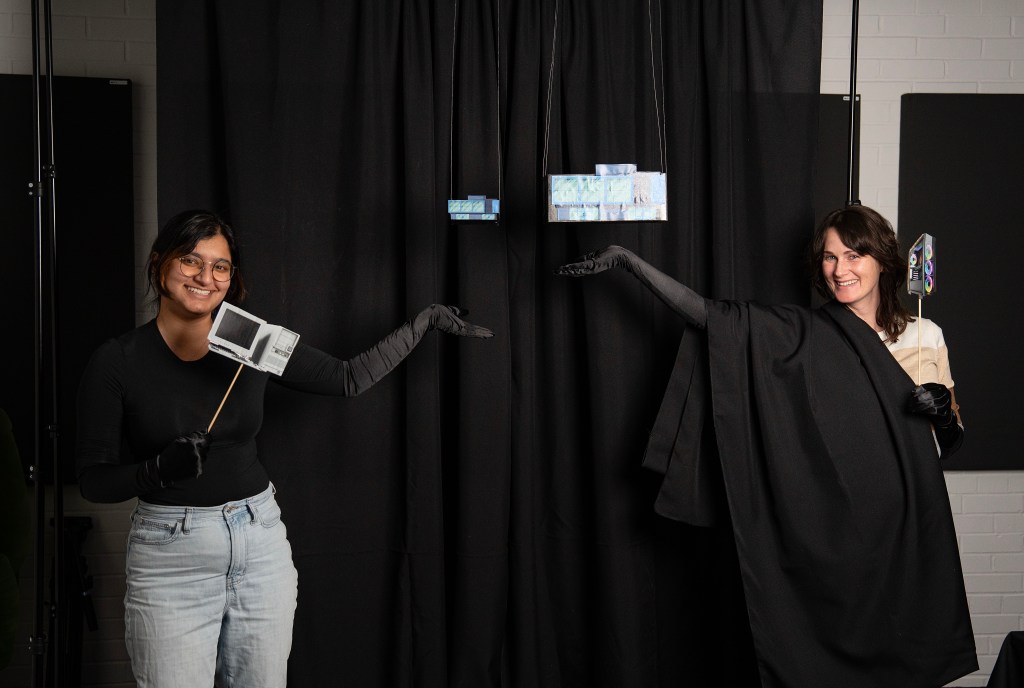
Meghana Kumar expected her introductory literature course at Purdue in Indianapolis to be like her high school English classes — that is to say, surface-level.
Instead, she took field trips to art galleries, read out scenes from Shakespeare and wrote poetry. Not only was Kumar invested in the assignments, but she also learned from her classmates through discussion.
She loved the class so much she’s planning to take more writing and literature courses as she works toward her mechanical engineering degree.
“Being able to discuss (stories) as a group has led me to understand different perspectives that I wouldn’t have normally thought of,” Kumar, 18, said. “That exchange of ideas has opened my eyes.”
That class is part of Purdue’s Cornerstone curriculum, a set of liberal arts courses that aim to help students studying science, technology, engineering and math build communication and writing skills.
Cornerstone is the only liberal arts program at Purdue in Indianapolis and the school is only offering the two introductory classes right now. But Purdue is planning to add more courses in the coming semesters so Indianapolis students can complete a liberal arts certificate like the one offered in West Lafayette.

Through Cornerstone, Purdue hopes students will learn about these subjects through discussion and coursework while leveraging their critical thinking skills for success in their future jobs.
“My perception is that a lot of what our STEM students learn is very binary,” said Lori Sparger, chief operating officer at Purdue’s College of Liberal Arts. “What they learn from us is all of the gray area in between. All of the nuance — that is what’s going to inform their real-world decision making and position them to be the engineers who lead companies.”
Bridging STEM and liberal arts
In 2015, Mitch Daniels, who was Purdue’s president at the time, expressed concern that not enough students were taking liberal arts classes.
In response, faculty created the Cornerstone program in 2017, a sort of buffet of liberal arts courses that integrated science and technology concepts with art, literature, history and philosophy.
“We’re trying to help begin that journey of them thinking critically and apply it to the major they’re in,” said Joel Ebarb, associate executive dean for Purdue’s College of Liberal Arts. “If you’re an engineering major, it’s not enough to know how to do something, but should you do it? What are the repercussions of doing it? What about the people that will be impacted by what you’re doing?”

Cornerstone is anchored in two entry-level literature classes for first-year students, one on writing and one on speaking. These courses fulfill Purdue graduation requirements for communication.
Beyond the two introductory classes, students can choose to take three more higher-level courses and work toward a Cornerstone liberal arts certificate. There’s a variety of options, everything from scientific philosophy to the history of the space age.
Ebarb said Cornerstone has not only revitalized Purdue’s liberal arts programs, but has helped thousands of students build skills that help them in the hiring process.
“It is going to give them an advantage over a student who maybe didn’t have these experiences when they’re in a job interview,” he said. “(They can say), ‘I can do all these things over here, but I’m also a great collaborator, communicator, creative and critical thinker.’”
Cornerstone in Indianapolis
When Tulin Tosun teaches a text like Mary Shelley’s “Frankenstein,” she’s not concerned about her students picking up on every instance of imagery or foreshadowing.
Instead, she wants to encourage them to make connections between the stories they’re analyzing and their own lives.
“There’s no right, no wrong,” said Tosun, who’s a professor and assistant director of Cornerstone Indianapolis. “It’s all open to interpretation, and we all learn from each other.”

When deciding what aspects of West Lafayette’s curriculum to integrate in Indianapolis, Cornerstone was high on the list. Professors hope that students will be able to learn outside the classroom by taking advantage of the city’s museums and theaters, especially as Purdue expands its liberal arts offerings in Indianapolis.
“You just need to create this interesting classroom,” Tosun said.”It’s just not like, ‘Let’s sit, write or read.’ How can we make literature more interesting for STEM students so they can enjoy it?”
For first-year Ameera Paunikar, the hours she spent in Tosun’s class this fall were a break from her engineering and math courses.
“I could express whatever I wanted to and it would be right,” Paunikar, 18, said.
Throughout the semester, Paunikar grew more confident sharing her opinion with her classmates in both small groups and discussion. The class helped her break out of her comfort zone, and she can already tell it’ll help her in the future.
“In any job, you have to talk to people and exchange ideas, and I think this course has taught me how to do that,” she said.
Claire Rafford covers higher education for Mirror Indy in partnership with Open Campus. Contact Claire at claire.rafford@mirrorindy.org or on Instagram/X/Bluesky @clairerafford.