When author Timothy Egan first started looking into the Ku Klux Klan’s influence in the 1920s, he wasn’t sure how he was going to write about it.
Then, he discovered the story of Butler University graduate and Irvingtonian Madge Oberholtzer: a 28-year-old woman who gave a detailed deathbed confession accusing Ku Klux Klan grand dragon D.C. Stephenson of raping and murdering her.
Oberholtzer’s statement would eventually lead to Stephenson’s arrest and murder conviction in Noblesville, stopping a man with political ambitions reaching as high as the White House.
“She’s the resister. She’s the one that stood up,” Egan told Mirror Indy. “Had I not found Madge, I’m not sure I would have had the book.”
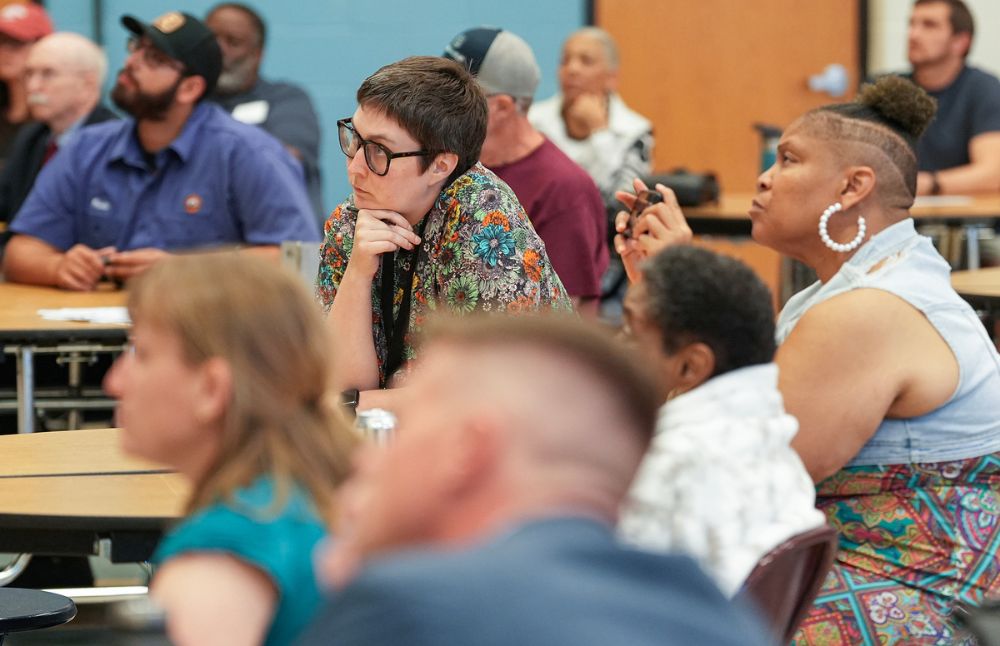
The Indianapolis Public Library brought Egan to town for its annual Marian McFadden Memorial Lecture March 20, where Egan talked to a packed auditorium at the Madam Walker Legacy Center about that history and what it means for Indianapolis right now.
In his book, “A Fever in the Heartland,” Egan tells the history of how Stephenson and the KKK ran Indiana in the 1920s.
The impact was startling: One in every three white men in Indiana swore fealty to the Klan, and in Indianapolis, nearly every public office — from the governor to the mayor — was under the Klan’s influence.
Egan’s book made a point to emphasize that Klan members weren’t on the fringe of society, they were “pillars of the community” — and the fact that the Klan was everywhere brought in more members.
“That was one of the most powerful things,” Egan said. “There was this feeling that you were missing something if you didn’t join this secretive organization.”

Here are some takeaways from Egan’s talk, as well as an interview with Mirror Indy earlier that day:
The resilience of Indiana Avenue
The Klan rose to power in Indiana in the 1920s around the same time that the Great Migration brought thousands of Black people from the South to Indiana, especially to Indianapolis.
Egan posited that the period of great change of the early 20th century — an influx of immigration, the Great Migration and social liberation of women — led many people to seek solace in the Klan, an organization that promoted “traditional,” puritanical values.
“There’s all this change,” he said. “To Indiana, which is a very homogeneous state — was then, still is — that’s seen as threatening.”
As the Klan rose to power, they promoted segregation, limiting where Black families could live, work and shop in Indianapolis.
But Indiana Avenue thrived even as its patrons were persecuted. The Avenue wasn’t just a hub for Black culture and music; it was an epicenter for resistance to the Klan in Indianapolis, spearheaded by the NAACP.
“Indiana Avenue is a source of joy, light, culture, music,” Egan said, “the counter to the darkness.”
The importance of teaching — and learning — history
After “Fever in the Heartland” was published in 2023, Egan said he heard from many Hoosiers saying they’d never learned about Indiana’s history with the Klan.
But the city’s newspapers, including the Indianapolis Star, documented — and were often sympathetic to — the Klan’s events and activities.
“Anyone who thinks this story is hard to find has not looked,” Egan said. “It was everywhere. You open up a newspaper from the 1920s, it literally pops out.”
So how could it be that so many people don’t know this history? Egan argued that “willful amnesia” allowed people to, generations later, bury the more shameful parts of Indiana’s past.

“The parallels to today — they’re obvious. If you don’t see these parallels today, you haven’t read history correctly.”
— Tim Egan, author of “Fever in the Heartland”
Egan noted there are parallels today. The Trump administration, for instance, is trying to force schools to pull back from teaching about diversity, equity and inclusion. And the same debate has been playing out at the Indiana Statehouse in regards to history in K-12 schools.
“I don’t think it’s ‘woke’ history,” Egan said. “I think it’s history. I think it’s what happened.”
Parallels to current political climate
As a storyteller, Egan said he sees his role not as an analyst of history, but as a chronicler of it.
“I look for a good story,” he said. “This is a sad story, but it’s a spectacular story in terms of good and evil characters.”
When asked if he sees his book as a call to action for people today, Egan said he prefers to leave the organizing to others. But, he said, there’s no denying that some rhetoric today echoes what the Klan espoused a century ago.
“The parallels to today — they’re obvious,” he said. “If you don’t see these parallels today, you haven’t read history correctly.”
How to learn more
Egan’s lecture was part of a yearlong events series from the Indianapolis Public Library and several other community organizations to commemorate the 100th anniversary of Oberholtzer’s death and Stephenson’s trial.
In addition to reading “A Fever in the Heartland,” here are some places you can go to learn more:
- Visit the Indiana Historical Society’s RESIST! traveling exhibit about Notre Dame students standing up to the KKK in 1924
- Take a walking tour of Irvington March 29
- Learn about Dr. John Kaylor Kingsbury, the doctor who testified against Stephenson, at an Irvington Historical Society exhibit
- See the new mural in honor of Madge Oberholtzer at 5606 E. Washington St. in Irvington
Claire Rafford covers higher education for Mirror Indy in partnership with Open Campus. Contact Claire at claire.rafford@mirrorindy.org or on Instagram/X/Bluesky @clairerafford.