A band-style comb, perhaps placed in a child’s hair before burial.
Buttons from a Union army coat, buried with a potential soldier.
What may be a figurine of St. Barbara, patron saint of artillerymen, architects, mathematicians and miners, tucked near the head of a roughly 2-year-old child.
These are some of the items that are starting to paint a picture of the lives — and deaths — of the people whose remains have been recovered at the site of Greenlawn Cemetery.
In October, city contractors broke ground on the Henry Street bridge project, which will connect the new Elanco headquarters to downtown.
Since then, archaeologists have been meticulously excavating the roughly 1.5-acre strip of land that intersects with two of four historic cemeteries collectively known as Greenlawn Cemetery. The rest of the cemetery site to the north is privately owned and unrelated to the city’s project.
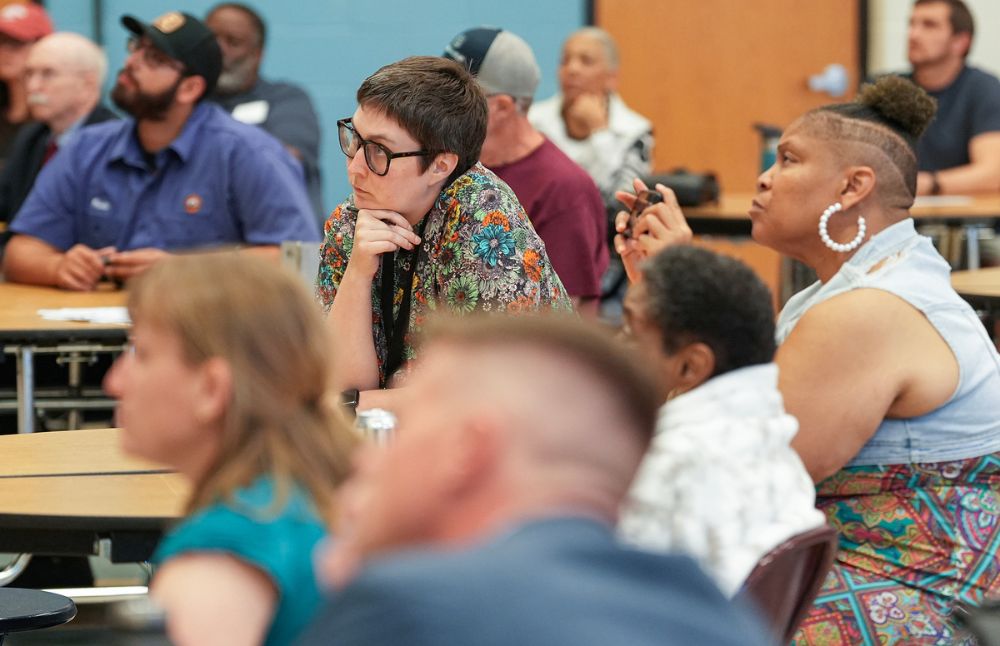
On July 8, city officials hosted a public meeting to provide extensive updates on the bridge project and what’s been discovered during the city’s excavation. Here’s what we learned:
More than 1,100 graves identified
Since work began on the city-owned portion of Greenlawn last year, archaeologists have uncovered 1,136 grave shafts. Those grave shafts may or may not contain human remains, and it will take more time to determine how many individuals have been recovered.
Ryan Peterson, a Stantec archaeologist working for the city, shared some additional details.
Archaeologists have found 511 intact burials, meaning a grave containing full skeletal remains. In addition, there were nearly 300 instances where buried remains were likely relocated at some point in the past but some bones were left behind.
Only 17 graves were completely empty.
Archaeologists dig inch by inch
In order to prevent damage to any potential remains, excavation begins by mechanically stripping the earth inch by inch, according to Peterson. A lighter stain in the soil indicates a grave has probably been dug there.
Each grave is documented and mapped with GPS and drone technology.
Then, archaeologists continue excavating by hand, passing soil through quarter-inch construction mesh.
Once remains are exposed, graves and remains are photographed and documented using archaeological software.
Remains are then carefully removed and sent to a lab at IU Indianapolis for additional study.

Buried objects give us insight
Brooke L. Drew, a historical archaeologist, described the extensive documentation for items found alongside human remains.
These can include headstones, coffin hardware, clothing, jewelry, items left intentionally at burial or things accidentally dropped.
Studying these items gives investigators a starting point for identifying individuals, she said, and gaining insight into their lives.
For example, Drew pointed to a long, heavy brass chain with a brass pendant that was found around the neck of a child who was likely 2.
“It’s unlikely that this robust, substantial piece belonged to someone so young, but it’s not hard to imagine it being something favorite of her mother,” Drew said. “Something her mother chose to part with so her little girl could keep it forever.”
Once these items are documented, they will be returned to the remains and reburied together.
Bones offer us even more detail
Once remains are sent to an IU Indianapolis lab, they are cleaned and inventoried to make sure there are no duplicates within a single set of remains.
The bones are then analyzed to determine their age, biological sex, stature, biogeographic ancestry and conditions that indicate their health history, including signs of scurvy, rickets and bone fractures.
“We have a few individuals that were amputees, meaning their limbs in particular were cut at or around the time of death with no evidence of healing,” said Jeremy Wilson, the bioarchaeologist who leads the lab. “Nineteenth-century medicine was what it was, and the common practice was to cut something off if it was infected. But unfortunately for the individual, that didn’t often lead to their survival.”
So far, Wilson’s lab has completed analysis for about 250 reburials. Of those burials, about 40% were 18 or younger. The oldest person was estimated to be 82.


Evolving understanding of racial composition
The lab is also starting to understand the racial composition of the people who were buried there. Of the remains Wilson’s lab has analyzed so far, they are roughly equally distributed between Black and white ancestries.
Historical records uncovered prior to the excavation referred to a segregated section of the oldest cemetery. It’s unclear exactly where that section would have been located, though the records suggest it was in the OId Burying Ground near the river.
Wilson noted, however, that the area that has been excavated did not appear to be segregated, at least in practice.
The ongoing discoveries continue to confirm the site’s significance to the city’s history, said Eunice Trotter, director of Indiana Landmarks’ Black Heritage Preservation Program. She is also part of the Community Advisory Group, which meets regularly with the city to discuss the project.
“This is an extremely significant site because this is the city’s first public burial ground for everyone, including African Americans,” Trotter told Mirror Indy. “So as we learn more about who’s buried there and who they are, we’re just going to open up a lot of doors of information about our history.”

Findings add to our understanding of history
The archaeological findings, combined with ongoing historical and genealogical research, continue to add to the city’s understanding of its earliest residents.
Most of the work so far has centered on the oldest cemetery, or the Old Burying Ground. This is where some of Indianapolis’ earliest settlers were buried.
Plots in this area were not sold or mapped like the other cemeteries near this site, according to historian Deedee Davis. So residents largely buried their loved ones where they wished.
Some burials in this area were relocated in 1924 to make way for a freight terminal, one of many uses of the land over the past century.
The second cemetery that falls within the city project’s footprint, Union Cemetery, was private, meaning plots were sold and documented.
But excavation on that cemetery has only just begun.
“This particular section, there was no excavation, no mass excavation” like there was for the Old Burying Ground, Davis said. “So this is going to be really interesting once we get to this site.”


Long road of research ahead
There is still much to be learned — and much work to be done — before the scientists and historians wrap up the project.
Excavation is set to continue, and Wilson’s lab will continue to analyze remains over the next two years. A reburial plan will be created after excavation.
Wilson said that, for each individual who is analyzed, researchers will produce an osteobiography — a narrative-like passage with whatever information can be gleaned from the remains.
Then, a larger report will be compiled. For reference, the final report for the relocation of Bethel Cemetery for infrastructure improvements at the Indianapolis International Airport was more than 3,000 pages long.
Much of that work is still ahead of the team working on Greenlawn.
“This cemetery has been erased and effaced for in excess of 100 years,” Wilson said, “and this is our unique opportunity to tell the story for each and every one of those individuals, and we’re committed to that.”

Looking ahead
The city will continue to provide updates on the excavation and historical research on a website.
As for the bridge project itself, contractors continue to work on infrastructure improvements on the west side of the river and are making preparations for the bridge over the river. The completion of the entire project will depend on the time it takes to excavate the area on the east side of the river.
The 20-plus acres north of the city’s land is owned by Indianapolis-based developer Keystone Group, which had proposed a $1.5 billion mixed-use development. The Hogsett administration pulled its support for the project last year, and the future of the site remains unclear.
Mirror Indy, a nonprofit newsroom, is funded through grants and donations from individuals, foundations and organizations. Sign up for our free newsletters.
Emily Hopkins is a senior reporter at Mirror Indy. You can reach them by phone or Signal at 317-790-5268 or email at emily.hopkins@mirrorindy.org. Follow them on most social media @indyemapolis or on Bluesky @emilyhopkins.bsky.social.