Pete Buttigieg, former U.S. transportation secretary and South Bend mayor, gives a speech Sept. 18, 2025, at the Indiana Statehouse in Indianapolis. Public officials spoke out against recent efforts for states to redraw their districts between census years.
Felechia Bayless-Mickles, a northside Democrat and a veteran, said she doesn’t want voices like hers silenced.
“They’re trying to wipe out the Black vote,” the 65-year-old said. “People need to be heard.”
Yovonna Nevins, a 59-year-old independent and eastsider, held back tears. “I’m here for democracy and my grandchildren,” she said. “If they could win on their merit, they wouldn’t gerrymander at all.”
And Steve, who only gave his first name because he fears being targeted for speaking up, wore a red shirt that said, “I’m a Republican with a freakin’ brain.”
“My dad and my grandfather were all veterans who went to war to fight for democracy,” he said. “And we’re just going to hand it away to some draft-dodging traitor?”


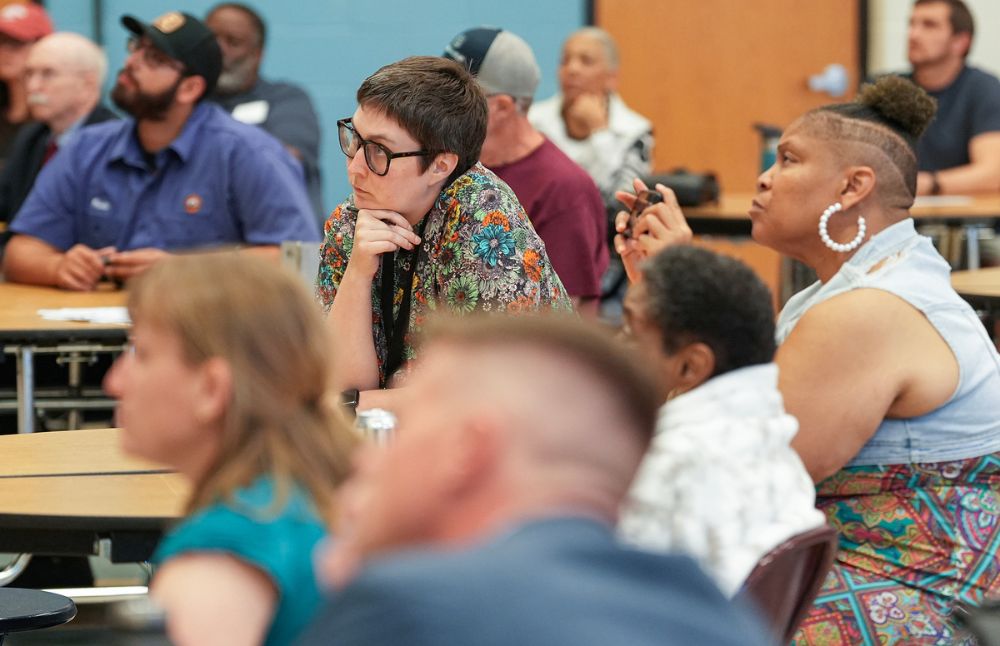
They were among the roughly 1,000 people of all political stripes who packed the Indiana Statehouse on Thursday, Sept. 18, to protest President Donald Trump’s push to redraw Indiana congressional maps. The president has said he wants to give Republicans a greater advantage ahead of the 2026 midterm elections.
The process to redraw maps, known as redistricting, enables whichever party holds power to use past voting trends to guide their decision-making. It typically happens every decade following the release of new U.S. Census Bureau data, but many Republicans are hoping to redraw the maps this year to help maintain their control of the U.S. House of Representatives.
“If we try to drag our feet as a state on it, probably, we’ll have consequences of not working with the Trump administration as tightly as we should,” Gov. Mike Braun, a Republican, told Fort Wayne’s WOWO radio on Sept. 15.
And the assassination of conservative activist Charlie Kirk has become a rallying cry to support the effort. Kirk had previously threatened to support primary challengers against any Indiana Republicans who did not agree to redraw the maps.
In Indiana, seven of the seats are already held by Republicans. The other two — one in northwest Indiana and the other in Indianapolis — are considered vulnerable by Democrats and political experts.
About 40 minutes before the rally kicked off, the first round of chants began: “Save our seats!” Soon people were shouting “no kings!” and waving signs from the upper floors of the Statehouse.


The event was organized by the Indiana Democratic Party and supported by several other groups.
“It’s rigging, cheating, whatever you want to call it,” said Brett Voorhies, a steelworker from Speedway who leads Indiana AFL-CIO, a labor group. “We’re supposed to have a democracy, but this is nothing but a dictatorship in disguise.”
‘Elections become meaningless’
Democrats brought their own national figure to the fight: Pete Buttigieg, the Democratic former mayor of South Bend, and, more recently, the U.S. secretary of transportation under President Joe Biden.
“The agenda of Washington Republicans is so unpopular, even here in Indiana they are afraid of losing if they have to run on a fair map,” Buttigieg told the crowd, who erupted in applause.

The battle here mirrors others playing out across the country as Trump seeks to keep the slim Republican majority in Congress. Historically, the president’s party usually loses ground in the midterms.
In Texas, Republicans have redrawn maps to pick up more seats, while California Democrats have moved to cancel out their efforts. Missouri was next to enter the fold. Like Indiana, it is controlled by a Republican supermajority where Democrats have no power to stop redistricting.
Greg Shufeldt, an associate professor of political science at the University of Indianapolis, has seen unofficial Indiana redistricting maps floating around on social media.
One would carve up blue Marion County, currently represented by Democratic U.S. Rep. André Carson, into three congressional districts that contain far more Republican voters outside of Indianapolis.
“Elections become meaningless when elected officials pick their constituents, rather than the other way around,” Shufeldt told Mirror Indy.

State Senate Minority Leader Shelli Yoder. Credit: Brett Phelps/Mirror Indy/CatchLight Local/Report for America 
State Rep. Matt Pierce. Credit: Brett Phelps/Mirror Indy/CatchLight Local/Report for America 
State Sen. Andrea Hunley. Credit: Brett Phelps/Mirror Indy/CatchLight Local/Report for America 
Terre Haute Mayor Brandon Sakbun. Credit: Brett Phelps/Mirror Indy/CatchLight Local/Report for America

Democracy in Indiana, he said, is under threat from more gerrymandering — a term to describe the process of redrawing political maps to win an election by packing in like-minded voters or dividing your opponent’s voting bloc. The Supreme Court ruled in 2019 that federal courts have no authority to intervene in cases of partisan gerrymandering.
“Whether or not it’s legal,” Shufeldt said, “this is a political party abusing the institutional rules and violating democratic norms.”
There is room for legal challenges, though. Generally, states are barred from racial gerrymandering, which targets minority voters in redrawn maps.
Carson, who could see the boundaries of his congressional district in Indianapolis changed, said lawsuits would follow immediately.
“This is a place of rich diversity and rich Black history unsurpassed throughout the country,” Carson told Mirror Indy in a phone interview. “And to break it up, in the midst of racial tensions and animosity, would be a tragedy for voters.”
A correction was made on Sept. 19, 2025: An earlier version of this article incorrectly stated which group organized the rally. The rally was organized by the Indiana Democratic Party.
Mirror Indy, a nonprofit newsroom, is funded through grants and donations from individuals, foundations and organizations. Sign up for our free newsletters.
Mirror Indy reporter Mary Claire Molloy covers health. Reach her at 317-721-7648 or email maryclaire.molloy@mirrorindy.org. Follow her on X @mcmolloy7.