When Donna Meek started hearing more and more about artificial intelligence, her first response was fear.
“What is this going to introduce in my life that I’m not going to understand?” Meek, 78, asked.
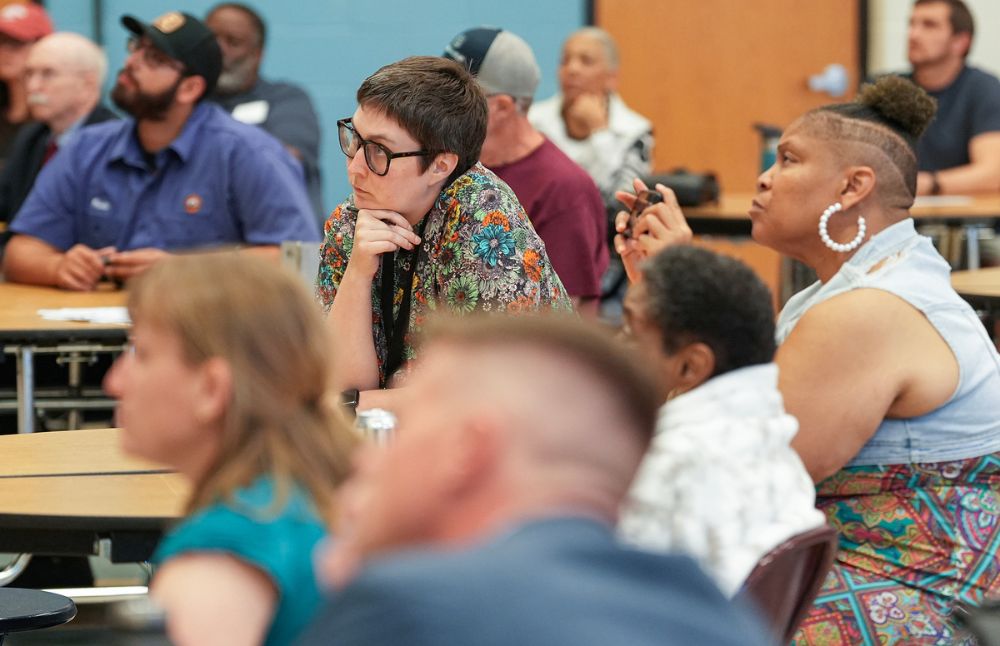
That’s why Meek decided to sign up for a free introductory AI class at the Indianapolis Public Library’s Nora Branch.
The Indy library started offering artificial intelligence classes earlier this year in response to requests from patrons. One course is a general overview of what generative AI is and how to use it, and another is specifically focused on how to recognize AI-generated content.

While artificial intelligence has been around for decades, the rapid development of large-language models such as ChatGPT has brought more users to the technology. But the technology is growing so fast that many people are struggling to understand how AI actually works.
A 2025 Pew Research survey found that over 50% of Americans were not confident they could tell the difference between AI-generated and human-created content.
There’s also a knowledge gap between generations. Per the Pew study, 62% of adults under 30 said they’d heard of or read about AI. That’s compared to just 32% of adults over 65.
Library staff hope that the AI classes will help people become more informed about artificial intelligence, whether they decide to use the technology or not.
“I just want people to be more confident talking about it,” tech learning specialist Dan Snodgrass said. “Because the less mystifying it is, the less it seems like magic, the more we can get down to like, ‘No, this is just information.’”

Knowledge is power
Before attending one of the AI overview classes at the library’s Nora branch, Pam Parks had only used ChatGPT a couple times.
Her sister had taken a similar class on artificial intelligence, and had encouraged Parks to experiment with the technology. But Parks also hopes that developing her AI skills might help her get a raise or promotion at work.
“I want to try to learn as much as I can,” Parks, who is 55, said, “to see if it’ll help me benefit.”
In her classes, tech learning specialist Janna Kreider wants to give students as much practical information about AI as possible.

In addition to defining terms such as large-language model and generative AI, the class dives into how to use ChatGPT or Google Gemini for tasks such as creating grocery lists or meal plans.
A large part of the class is interactive, with students exploring AI tools on library-provided Chromebooks with help from library staff.
“My goal is that they walk away knowing how to get what they need if the class didn’t answer that question, and take away a brand-new set of tools,” Kreider said.
For Mike Biro, one of the students at the class, that’s exactly what Kreider taught him. While he’s recently been using ChatGPT to help him customize his resume for certain jobs, the library’s class helped him expand his views about what AI can be used for.
“It’s really opening me up to different things,” Biro, who is 56, said.

Meek, however, doesn’t think she’ll use AI tools more often after taking the class. But knowing more about how the technology works makes her feel more empowered and a bit less afraid.
“I’m a firm believer to keep challenging yourself,” she said.
Tips and tricks
If you can’t make it to a class, here are some tips for using generative AI models and recognizing AI-generated content online.
- Always click on the links in an AI-generated summary. Sometimes AI will draw incorrect conclusions from information it compiles, so going to the original source to check is a good idea. “That’s the simplest thing you can do,” Kreider told students in the Feb. 10 class. “You can at least see, does this thing that the AI is referencing actually exist?”
- Don’t use AI to research topics where you wouldn’t recognize misinformation. “If you’re not familiar with the information, you might not recognize some bad information when you get it,” Kreider told students. “Information that you’re using as a source should be verified.”
- Look for watermarks or blurring on images and videos. Some AI generators, such as Gemini, will create a tiny identifying logo to show that the image or video is AI. This isn’t the most reliable method, as these logos can be cropped out or removed digitally. If the logo is removed, though, there may be a blur or smudge where it was deleted.
- Videos shorter than 10 seconds are more likely to be AI-generated. “If it is 10 seconds or under, look at that with more skepticism,” Snodgrass said. “AI generators are really good at creating that 10 seconds.”
If you’re interested
Here are the upcoming dates and locations for the Indianapolis Public Library AI classes. The highlighted date below will take you to the page for that class, where you can register.
If a class is full, you can join the waitlist.
AI overview classes
- Feb. 18: 2:05-4 p.m. at Michigan Road Branch, 6201 N. Michigan Road.
- March 7: 2-4 p.m. at Glendale Branch, 3660 E. 62nd St.
- March 23: 2-4 p.m. at Central Library, 40 E. St Clair St.
- April 13: 5:30-7:30 p.m. April 13 at Lawrence Branch, 7898 Hague Road.
- April 15: 2-4 p.m. at West Perry Branch, 6650 S. Harding St.
- April 25: 10:30 a.m. to 12:30 p.m. at Fort Ben Branch, 9330 E. 56th St.
Recognizing AI-generated content
- March 24: 5:30-7:30 p.m. at Beech Grove Branch, 1102 Main St., Beech Grove.
- April 7: 5:30-7:30 p.m. at Fort Ben Branch, 9330 E. 56th St.
- April 13: 2-4 p.m. at Eagle Branch, 3905 Moller Road.
- May 2: 10:30 a.m. to 12:30 p.m. at Fort Ben Branch, 9330 E. 56th St.
Mirror Indy, a nonprofit newsroom, is funded through grants and donations from individuals, foundations and organizations. Sign up for our free newsletters.
Claire Rafford covers higher education for Mirror Indy in partnership with Open Campus. Contact Claire by email claire.rafford@mirrorindy.org, at 317-759-0249 or on most social media @clairerafford.