At Central Library downtown, Ally Scott pointed at a map of Indianapolis.
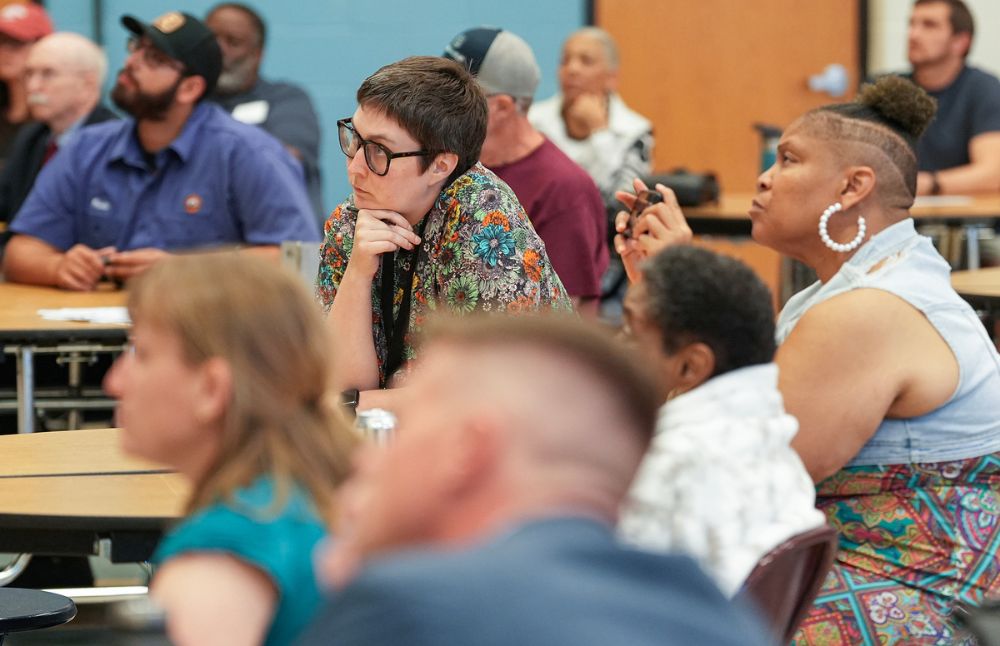
“Where you live matters,” Scott told about 30 people gathered March 6.
For example, Black residents make up only 15% of Central Indiana’s population — but, a new study found, they live in a little more than half of the areas at risk for worse health outcomes.
Those outcomes, including cancer, heart disease and poor mental health, are tied to inequities in education, job opportunities, housing, food access and medical care. Researchers found the disparities were particularly prominent in neighborhoods on Indy’s east, west and south sides.
“These factors actually account for 80 to 90% of health outcomes,” said Scott, a data analyst for the Polis Center at IU Indianapolis, a research hub that released the report.
That statistic did not surprise Danita Hoskin.
The 64-year-old is the president of the Crown Hill Neighborhood Association. Residents on the near north side face health disparities and the long-term effects of racism and housing discrimination; life expectancy here is two decades lower on average than in other parts of the city, according to Indy Health District.
The new nonprofit started tackling issues on the near north side last year. But for many decades, Hoskin said, trying to get the city to pay attention to her neighborhood was like “bringing a rock to a gunfight.”
“You really have to band together,” she said. “I wanted to be at the table where the decisions are made.”
That’s why she leads her neighborhood association. Last October, Hoskin celebrated Indy Health District’s $500 million investment in Crown Hill and four other neighborhoods. But she still wants to learn more about the origins of the disparities.
“You can have all the passion in the world,” Hoskin told Mirror Indy, “but you need data.”
The Polis Center used federal data — from the Centers for Disease Control and Prevention and the census — to map health outcomes in 11 Central Indiana counties. Not much changed from previous data in 2013. Hamilton County still had the highest life expectancy, while Marion County had the second lowest.
Researchers said they hope the information can be used by policymakers — though it’s already at risk of being politicized.
CDC data used in the project briefly disappeared as the Trump administration purged thousands of government web pages following a slew of new executive orders.
“There’s also a risk of data not getting updated in the future,” said Jay Colbert, the data manager at the Polis Center.
Community members came curious to the event, which was presented in partnership with WFYI Media. They shared additional topics they wanted to see researched, including access to early childhood education and the effects of climate change.
Autumn Murphy asked about sleep and noise pollution. The 32-year-old attorney from the Bosart Brown neighborhood on the east side hears a lot of traffic at night. She was grateful for the project and hopes research like this will continue to exist.
“It only serves the status quo to stop collecting data,” Murphy said. “Why do we not want to know what’s going on in our communities?”
Mirror Indy reporter Mary Claire Molloy covers health. Reach her at 317-721-7648 or email maryclaire.molloy@mirrorindy.org. Follow her on X @mcmolloy7.