When you walk into an Indy Offline event, the first thing you’re asked to do is to put your phone in a lockbox. You get to keep the key in case you get desperate for a dopamine hit.
Next, you decide if you’re up for talking to other humans. Yes? Grab a nametag. Not in the mood for conversation or eye contact? Feel free to disappear into that book you brought. It’s your 90-minute digital detox, and you can do whatever you want.
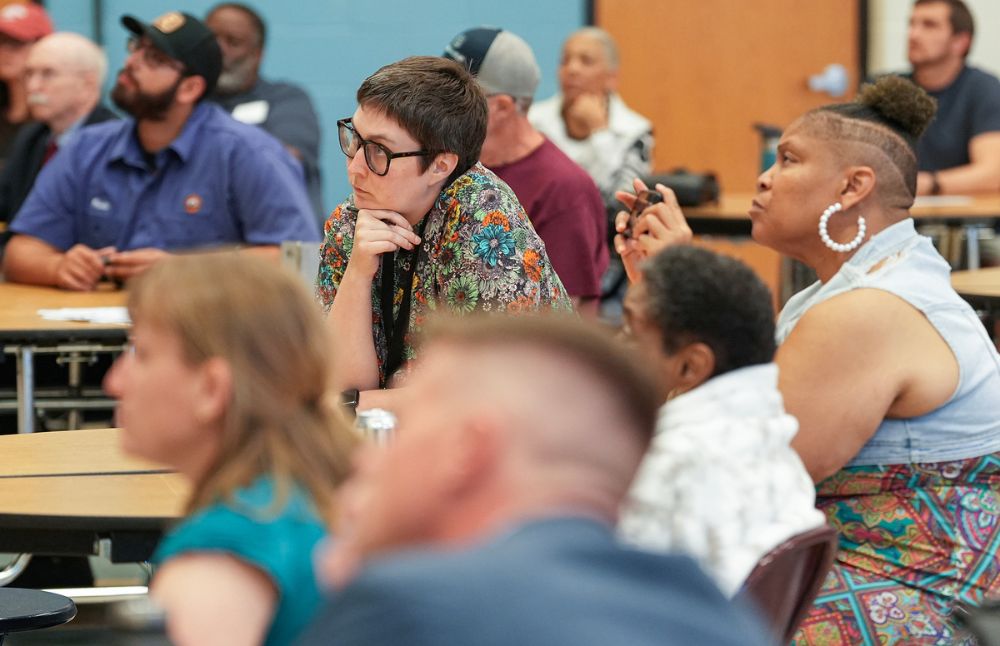
About a dozen people drove through pouring rain recently to meet at Orangily, an alcohol-free bottleshop in SoBro. Two nametag-free people silently read books. Four friends gathered around a table to work on a puzzle, while one talked about “1899,” the Netflix thriller about an immigrant ship that goes missing while enroute to New York. “It’s very disturbing,” she said.
At another table, Emily Mellentine, the 24-year-old founder of From Her Corner, a creative community, was sitting by herself when a woman sat down and offered to share her cheese and crackers.
“We started talking while she crocheted, and then another woman joined us to color and chat,” Mellentine said. “The three of us talked about acne, birth control, movies and hobbies. We connected really well and laughed a lot.”
The founder of Indy Offline, 25-year-old Hannah Cortes, said she started the events because she believes Gen Z is craving those types of low-pressure, in-real-life connections. Her generation is still dealing with the aftershocks of the isolation caused by the COVID pandemic. They’ve grown up mostly in online spaces, spaces that have become more divided and less trustworthy because of “rage-bait content, heavy monetization and AI.”

“With so much accessible through our phones, it can feel like there’s always something we should be doing.”
— Hannah Cortes, founder of Indy Offline

And then there’s the burnout that comes from living with what’s basically a pocket-sized, 24/7 slot machine.
“With so much accessible through our phones, it can feel like there’s always something we should be doing,” Cortes said. “Even small amounts of downtime are often filled with catching up on content, scrolling, watching or listening, which makes it harder to slow down.”
While traveling in Europe, Cortes learned about phone-free events and retreats hosted by the Offline Club, founded by three Dutch men in Amsterdam. The Offline Club has chapters in 20 European cities and 600,000 followers on Instagram. New Eventbrite data shows that global attendance at phone-free events grew 121% from 2024 to 2025.
Cortes, who works at the University Library at IU Indianapolis and is an intern at the Encyclopedia of Indianapolis, was inspired to bring the idea back home. Right now, Indy Offline — which is not an offshoot of the Offline Club — has about 850 followers. But, Cortes has only hosted a handful of events.
Americans, on average, check their phones 186 times a day, which has led to “attention activists” trying to take back control. In Indianapolis, coffee shops and bookstores, including Public Parlor House and Whispering Shelf, have hosted phone-free events. Anyone who went to the Jack White or Phoebe Bridgers concerts in Indianapolis this past summer had put their phone in a Yonder pouch.


Cara Carrion, a ticket services manager for the Indianapolis Indians, said she checks her phone about 75-100 times a day. She learned about April’s Indy Offline event in Mirror Indy’s daily newsletter, and went to Orangily to enjoy some “planned downtime.” Plus, she and her friends have been looking for more “third spaces” to socialize.
The hardest part of not having a phone for 90 minutes?
“Ignoring the impulse to grab it to check the time or check notifications,” said Carrion, 31. “It’s quite shocking when you don’t have your phone, how often you impulsively think about grabbing it. So staying focused while reading my book and not thinking about my phone was a bit of a challenge.”
To keep people busy, Cortes provides plenty of entertainment: Board games and card games, notecards and envelopes, stickers, mini-crochet kits, digital cameras, scissors, sketchbooks, gluesticks and yarn.
Mellentine spent much of her time drawing free-form with crayons. She’d planned to leave the event 30 minutes early to go to dinner, but stayed because she was having fun and making meaningful connections.
“I realized I hadn’t used crayons in a long time,” she said. “It took me back to being a kid.”
Mirror Indy, a nonprofit newsroom, is funded through grants and donations from individuals, foundations and organizations. Sign up for our free newsletters.
Amanda Kingsbury is Mirror Indy’s managing editor of innovation. You can reach her at amanda.kingsbury@mirrorindy.org.