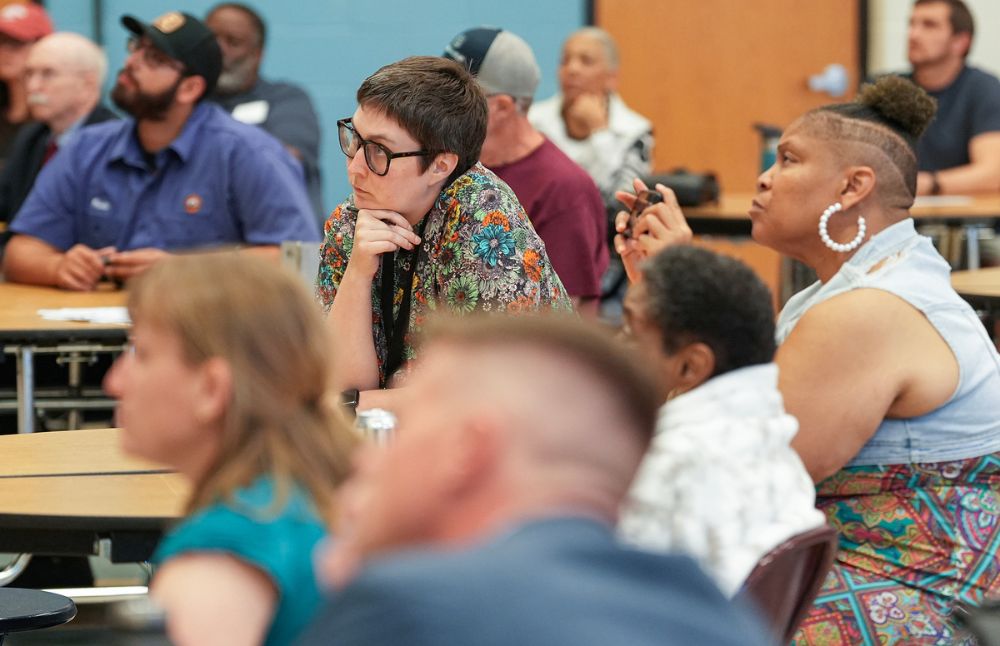
For more than a century, the Mary Rigg Neighborhood Center has helped thousands of westsiders every year get the food, job training and family services they need to thrive.
It spends about $3 million a year to provide those services at its building at 1920 W. Morris St. and at its new food pantry a few hundred feet away. Most of its funding comes from grants and donations.
But lately, fewer of the center’s dollars have been making it to clients and instead have gone to utility companies.
That’s because rates for electricity and natural gas have risen significantly here and across the country over the last year. The Iran war is expected to drive energy prices up even further.
“Utilities are high in cost, and they just keep going up, especially with the cold winter that we’ve had,” said Mary Rigg operations and customer service director Cindy Miers.

Miers said the center spends about $3,400 a month for electricity, but severe weather can drive up the bill even higher. After a week-long February freeze last year, Mary Rigg’s electric bill nearly doubled to $6,700.
High utility prices have led to an inquiry from the state’s utility regulatory commission. But until relief arrives, local nonprofits like Mary Rigg have sought new ways to save money on their electric bills.
They applied to receive thousands of dollars in energy efficiency funding from Thriving Nonprofits, a new program administered by the Indianapolis Office of Sustainability and community development financier IFF.
The Thriving Nonprofits program gives selected applicants free energy assessments and up to $10,000 in matching grants from the McKinney Family Foundation to facilitate building upgrades that reduce energy usage and lower monthly utility bills.
More than 40 organizations applied, but Mary Rigg was one of 10 Indianapolis nonprofits ultimately selected to receive funding.
The center received $6,000 to replace four drafty doors with ones that will help the organization save energy and allow it to spend more money on helping local residents.
Miers believes the center’s energy savings will pass on to people who depend on Mary Rigg services.
“I mean, think about it, if it saves us $100, it could save each neighbor 20 bucks. And $20 goes a long way for a neighbor,” Miers said.

Making every cent count
According to Sustainability Office community engagement manager Mads Gullion, the Thriving Nonprofits’ goal is simple.
“The less nonprofits spend on energy and utility bills, the more money there is that can go toward their mission,” she said.
Projects ranged from new solar panels and inverters for the Aspire House in the Northwest Landing neighborhood to new energy-efficient washers and dryers for Outreach Inc., an organization that helps homeless residents that has several locations throughout the city.
For the Mary Rigg Neighborhood Center, four new doors will go a long way toward helping their clients.
The building where the center currently operates was built in 1998. Miers said the old doors allowed heat and air to seep out, making the center’s HVAC unit work harder to maintain needed temperatures.
“Cold air was circulating and coming into the gym. There’s a little heater that sits in that entryway there, so I’m hoping it will run a little less now, too,” Miers said.
The free energy assessment also identified another area where the center could save a lot of money on energy — its windows.

According to the Environmental Protection Agency’s Energy Star program, replacing old windows with energy efficient ones could save a typical household up to 13% on heating and cooling costs.
For buildings like Mary Rigg’s, which has dozens of windows, the savings could be even more significant. But Miers said that with a $100,000 replacement estimate, the center will have to find more funding to move ahead with the upgrades.
More information
The Thriving Nonprofits program began in May 2025 and was inspired by similar initiatives in Bloomington and South Bend.
To see a full list of grant recipients, check out the city’s announcement. For information on how to apply for the grant in the future, head to the Thriving Nonprofits website.
Mirror Indy, a nonprofit newsroom, is funded through grants and donations from individuals, foundations and organizations. Sign up for our free newsletters.
Mirror Indy reporter Enrique Saenz covers west Indianapolis. Contact him at 317-983-4203 or enrique.saenz@mirrorindy.org. Follow him on Bluesky at @enriquesaenz.bsky.social.