The upcoming election season will ask Indiana voters to make critical decisions about how schools are funded and who sits on local school boards.
Shaping these decisions are new laws taking effect this year that allow school board candidates to run under partisan labels, and change how districts seek property tax referendums.
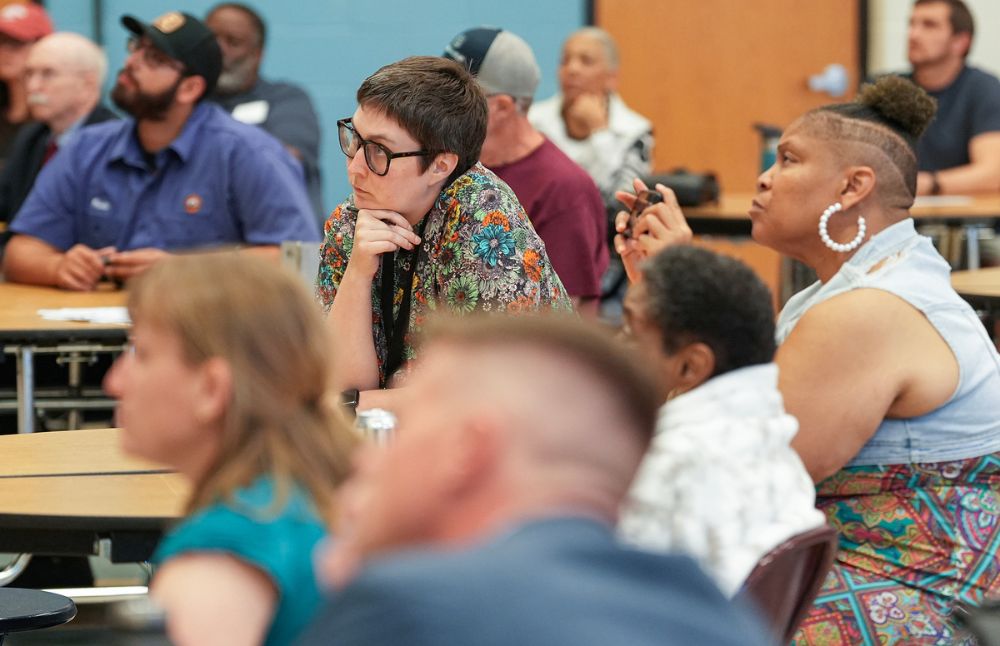
To explain how these changes may affect the makeup of school boards and future funding for schools, Chalkbeat hosted a panel at the Eugene and Marilyn Glick Indiana History Center in Indianapolis on Wednesday featuring three experts:
- Terry Spradlin, executive director of the Indiana School Boards Association.
- Ashley Thomas, District 1 IPS commissioner, and member of the IPEC board.
- David Roof, associate professor in the Department of Educational Studies at Ball State University’s Teachers College and Director of the Center for Economic and Civic Learning.
- Here are five takeaways from the discussion.
Half of school board candidates choose party affiliation
Beginning this year, under a new state law, school board races in Indiana will shed their nonpartisan label and allow candidates to declare a party affiliation. There are no primary races for school board, meaning more than one candidate in a race may be a Democrat or Republican. For this reason, straight-ticket voting won’t include school board races.
Candidates can also choose to remain nonpartisan, or label themselves independent.
Of 1,044 school board candidates who have filed for office statewide, 524 have chosen a party affiliation, according to data from the school boards association shared by Spradlin. Around 72% of that number are running as Republicans, 6% are running as Democrats, and 7% are running as independents.
There are a number of reasons candidates may have chosen a partisan label, the panelists said. For example, listing a party puts a candidate higher on the ballot, Spradlin said. Not listing a party might make voters think a candidate has something to hide, Roof said.
Another 516 candidates chose to remain nonpartisan, according to ISBA data. Approximately 60% of school board races have just one candidate, in line with previous years.
Effect of partisan labels remains to be seen
Supporters of the law previously said partisan labels give voters key information to make a decision. But panelists said that might not be the case in school board elections.
For one thing, there can be considerable differences between members of the same political party, Thomas said.
“Someone could be a Democrat and they could have completely different views on some really strong points compared to someone who sits in that same party,” Thomas said.
Plus, it’s not clear how much party affiliation matters for the responsibilities of school boards, which primarily focus on governance decisions, rather than legislative ones, Roof said. School boards are primarily responsible for hiring superintendents, approving budgets, and adopting policies. No school board member can make these decisions alone, Spradlin noted.
“One of the worries I have is that people will begin to see those decisions through a partisan lens and interpret the decisions that are made — the governing decisions — through a kind of partisan framework,” Roof said.
The years of heightened political tensions at school board meetings during COVID seem to be simmering down, panelists agreed.
At the same time, the 2025 Civic Health Index indicates Hoosiers appear less willing to discuss potentially divisive political issues or attend public meetings. That affects young people’s first experiences with civic engagement, Roof said.
“Our students are paying attention to adults and whether or not we can disagree respectfully,” Roof said.
Three dozen school districts — and counting — seek referendums
Indiana districts can ask voters to raise their own property taxes to help fund schools. Districts typically seek referendum funding for either capital or operating expenses. While capital referendums fund construction or renovations, operating referendums fund expenses like teacher pay, programming, and transportation.
So far, around three dozen districts plan to seek property tax referendums in the fall, and ISBA expects the final number to be around 55. Spradlin said that while the number seems higher than in the past, it reflects the changes lawmakers made to limit when school districts can seek referendums.
This year, districts are asking voters to consider these tax increases in a time of increasing household costs, creating some uncertainty about whether the referendums will pass.
But districts are grappling with rising costs, too, Spradlin said. The majority of a school district’s operating fund goes to insurance, transportation, and utilities, he said, and energy rate hikes are outpacing inflation.
“What districts are pursuing are not really expansive revenue requests to add new programs or build new buildings,” Spradlin said. “These requests are simply to maintain the status quo, to continue to have enough funding for the momentum that we are seeing in our classrooms across Indiana.”
Thomas said districts should be transparent about how they’re spending referendum dollars. In Indianapolis, she said she has recommended an accountability ticker for all schools — including charter schools — that benefit from a referendum to explain how they’re spending the money.
Could sharing tax revenue with charters displease voters?
This year, Indiana lawmakers passed sweeping legislation requiring public school districts to share more property tax revenue with charter schools. Members of the audience wanted to know why they should support referendums if they fundamentally oppose this change.
Thomas said she heard from a constituent with this concern. She said she believes the economic climate will be more of an issue to voters than which schools would benefit from referendums.
“Any disruption that may happen for a referendum that doesn’t pass could be to the detriment of kids, no matter the school type,” she said.
Sharing the revenue means districts have to seek a higher rate, Spradlin said, which could make passing a referendum more challenging.
The next statewide budget could end referendums
Our audience also wanted to know: Is there a piece of legislation that could put an end to districts’ consistent need for referendums?
Spradlin said the next state budget could provide enough state funding to reduce the reliance on referendums.
“That’s the vehicle that we hitch our wagon to every two years and ask for adequate funding for public education in Indiana,” Spradlin said.
With talk of ending property taxes altogether, ensuring an adequate stream of funding is critical, he added. Over the next couple of years, the state will free up another $1 billion after paying off the teacher retirement fund liability — money Spradlin said should be reinvested in public education.
Thomas suggested that lawmakers reverse a 2025 law that made school vouchers open to all in order to ensure more funding is available for public schools.
In addition, providing special education services for Indianapolis students in both district and charter schools has left IPS in a multi-million dollar deficit, Thomas said.
Roof added that lawmakers could tackle specific initiatives, like the recommendations from the Next Level Teacher Compensation Commission, or proposals to implement universal preschool.
This article was written by Chalkbeat Indiana reporter Aleksandra Appleton.