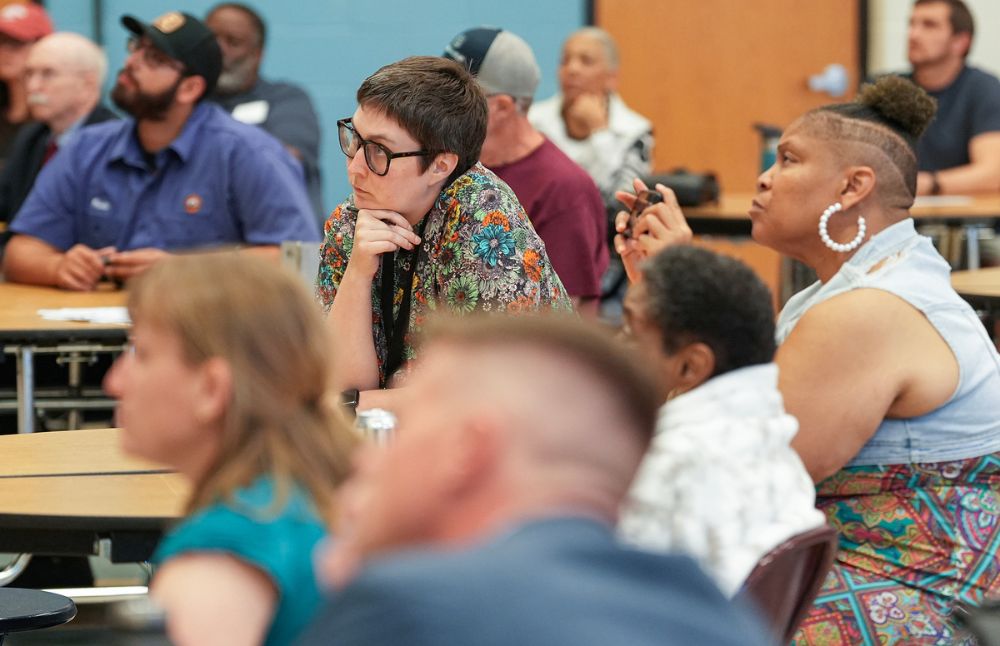
The 49 people who testified on the Blue Line bill last week at the Statehouse left without a clear answer on the fate of the Indianapolis bus project.
That’s because Rep. Jim Pressel, R-Rolling Prairie, who chairs the committee where the bill was being heard, decided to postpone a potential vote until Tuesday, Feb. 27 — the last day House committees can consider bills that originated in the Senate.
So what are the potential paths forward for Senate Bill 52?
Quick Blue Line background
The legislation would prevent IndyGo from using dedicated lanes for the Blue Line, a planned bus rapid transit route spanning roughly 25 miles along Washington Street and I-70, until July 1, 2025.
IndyGo officials have said Freeman’s bill would mean the city would lose out on $150 million in federal grant money for the project, which also includes infrastructure upgrades along Washington Street. But bill author Sen. Aaron Freeman, R-Indianapolis, is opposed to giving the Blue Line its own lanes on the east-west city corridor, citing concerns about traffic congestion.
Jennifer Pyrz, interim CEO of IndyGo, previously testified that Freeman’s bill would “effectively kill” the Blue Line.
What’s next for the bill (Tuesday)
The House Roads and Transportation Committee will hear amendments and potentially vote on SB 52 at 10:30 a.m. Tuesday.
Three amendments had been filed as of Friday afternoon:
- One would require IndyGo drivers who are driving in the opposite direction of the flow of traffic to sound a horn to alert pedestrians when approaching an intersection in the opposite direction.
- Another would allow the Blue Line to use dedicated lanes but place a ban on them in Indianapolis going forward.
- A third amendment would clarify that the one-year moratorium on dedicated lanes only applies to Marion County. As currently written, the law would apply statewide.
Hoosiers who want to testify about any of the amendments can sign up by filling out an appearance form.
After discussion, the committee would vote on whether to accept any of the amendments. Then it would vote on the most recent version of the bill.
However, the chair has the right not to call for a vote.
If the bill is voted down, it would die (at least temporarily, more on that below). If the committee approves the bill, it would advance to the full House.
Potential next steps
If the bill makes it to the House, any of the bill sponsors can call it down for second reading, where all representatives can vote and suggest amendments.
If it passes second reading, the House will take a final vote on third reading.
If the bill passes the House without any additional amendments, it would then be sent to the governor’s office for consideration.
If the bill passes the House with amendments, it would be sent back to the Senate. If the Senate approves the bill as amended, it would be forwarded to the governor’s office.
If the Senate doesn’t approve the changes made by the House, then the bill would be assigned to a conference committee, which consists of two lawmakers from each chamber.
The four members usually include two Democrats and two Republicans, though the Republican supermajority in control can (and often does) replace the two Democrats with Republicans.
That’s what happened last year with House Bill 1001, the vehicle bill for the state budget. Sen. Eddie Melton, D-Gary, and Rep. Greg Porter, D-Indianapolis, were initially appointed to the conference committee tasked with resolving differences in the legislation, but were later replaced with two Republicans after negotiations stalled.
If the conference committee reaches an agreement, then a committee report is sent to both chambers for a vote. Both the Senate and the House must approve the report before the bill can be sent to the governor.
The 11th hour
Conference committees also serve another purpose for whichever party is in power.
Even if the bill fails to advance through the House, that doesn’t mean the issue is dead. As a general rule, if a bill passes one chamber but fails in another, lawmakers can revive the language in conference committee.
That was the case last year, when Republican state lawmakers tacked language dealing with “obscene” library materials onto an unrelated bill that addressed third-party surveys and evaluations given to K-12 students.
Sometimes, issues that haven’t been publicly discussed make it into legislation anyway. The provision that allowed Indianapolis to create an economic enhancement district was made possible through a last-minute change to the state budget bill when it was in conference committee.
Can the governor veto it?
Republican Gov. Eric Holcomb could veto Senate Bill 52, but in Indiana, it would only take a simple majority — 51% — of both chambers to override it.
For that reason, Holcomb rarely stands in the way of a bill becoming law, though he did so in 2022, when state legislators passed a law preventing transgender girls from participating in girls school sports, and in 2021, when he took issue with legislation that would prohibit Indianapolis from regulating relationships between tenants and landlords. Lawmakers overturned both vetoes.
The legislative session is scheduled to adjourn March 14.
To learn more about how a bill becomes a law, check out this helpful flow chart.
Mirror Indy reporter Peter Blanchard covers local government. Reach him at 317-605-4836 or peter.blanchard@mirrorindy.org. Follow him on X @peterlblanchard.