Emmie Joy Brooks loved animals because they never hurt her.
The little girl spent most of her life at Riley Children’s Hospital in Indianapolis, poked and prodded by humans trying to keep her alive. Her dog, Marley, was a grumpy old Maltese with no teeth that hated everyone but her. She thought he was beautiful.

Emmie was born with a heart defect and CLOVES syndrome, a rare genetic condition that later caused cancerous tumors to grow on her kidneys. Life was best when she could see friends or play video games. It was the worst when chemotherapy and the usual drugs failed, leaving doctors to prescribe a toxic cocktail that permanently damaged nerves in her face and fingers.
“I’m not worried, Mom,” Emmie would say. “They come out with new drugs all the time.”
Tracy Brooks would stay silent. She couldn’t say what she was thinking: “If only that were true.”
Behind the scenes, the single mother of four was fighting with the insurance company to cover the treatments and praying that a pill that worked on lab rats would save her 13-year-old daughter. The family was running out of options.
“You bring your child to the brink of death to try to save them,” Brooks, who lives in Columbus, told Mirror Indy.
In the end, nothing worked. Emmie’s immune system was destroyed — not just from the cancer, but by the drugs meant to treat it. Her body couldn’t fight when she caught a bacterial infection.
On October 13, 2022, Emmie died from sepsis.

‘Enough is enough’
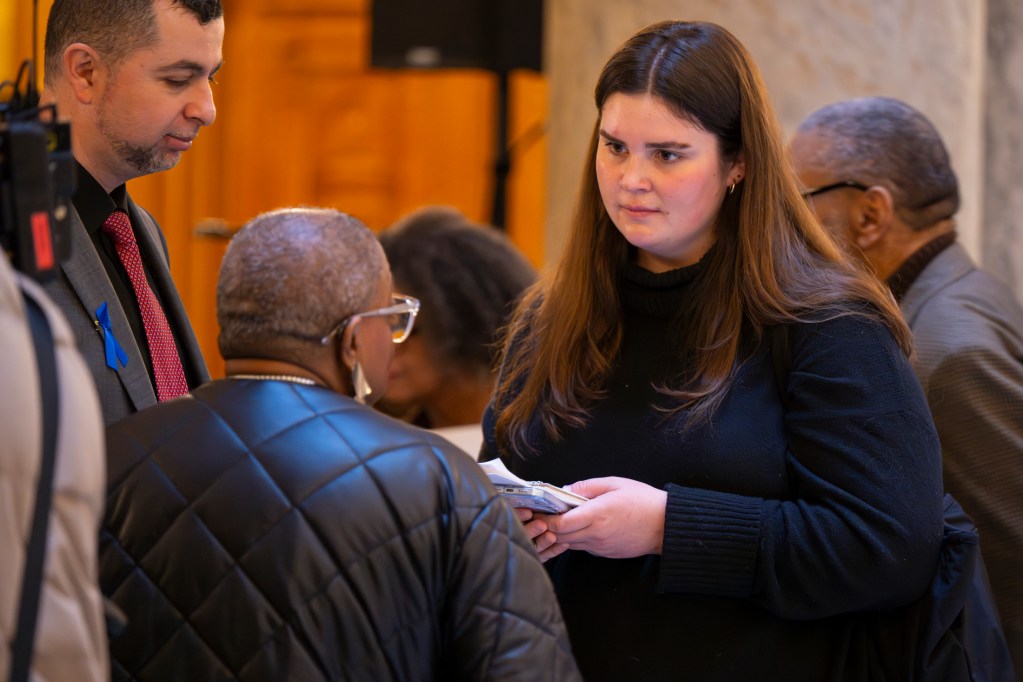
Brooks and dozens of other parents gathered at the Indiana Biosciences Research Institute last week to demand change. They were there for an event hosted by Elevate Childhood Cancer Research and Advocacy, an Indiana nonprofit.
Each person went around the room and said the name of their child. Then, the type of cancer. Lastly, the year they died.
“It’s too late for my daughter,” Brooks said to the group, “but it’s not too late for the kids that are going to be diagnosed tomorrow.”

Doctors and scientists bowed their heads. They’d studied tumor samples from some of these very children.
“My primary goal is to make sure we don’t have families like you moving forward,” Andrew Mesecar, a biochemist and director of the Purdue Institute for Cancer Research, told the group.
The road ahead is long and difficult. Cancer is the second leading cause of death for U.S. children ages 1 to 14. Yet pediatric cancer receives just 8% of federal funding for research — forcing children to take drugs developed decades ago for adults that wreak havoc on their tiny bodies.
“The treatments are archaic,” said Robyn Spoon, who founded Elevate Childhood Cancer Research and Advocacy, a nonprofit advocating for childhood cancer research after her son, Justin, died from rhabdomyosarcoma in 2023. “Even the kids that live, 95% of them end up having some kind of long term medical problem.”
She was part of advocacy efforts to include pediatric cancer in the Indiana Cancer Control Plan for the first time last year. The document highlights statewide goals, including more research into new treatments and increasing parent awareness of clinical trials.
“Enough is enough,” Spoon said. “We really need to figure out how to get therapies that are stuck in academia over the hump.”

Robyn Spoon hugs Tracy Brooks. Credit: Jenna Watson/Mirror Indy 
Dr. Reza Saadatzadeh, a cancer researcher, listens to a parent speak. Credit: Jenna Watson/Mirror Indy 
A handout. Credit: Jenna Watson/Mirror Indy 
CEO Robyn Spoon speaks. Credit: Jenna Watson/Mirror Indy 
Guests listen to speakers. Credit: Jenna Watson/Mirror Indy 
Jim Foote, cofounder of First Ascent Biomedical, speaks. Credit: Jenna Watson/Mirror Indy 
Tracy Brooks talks about losing her daughter Emmie to complications of cancer during a program hosted by Elevate Childhood Cancer Research and Advocacy at the Indiana Biosciences Research Institute at 16 Tech on Thursday, May 2, 2024. Credit: Jenna Watson/Mirror Indy
But even as parents like Spoon push for new treatments, they say it’s hard to convince for-profit pharmaceutical companies to invest.
“From an economics perspective, it doesn’t make sense to spend $5 billion on drugs that fail 97% of the time to get FDA approval on a patient population that is so small,” said Jim Foote, who founded a biotech company researching treatments after his son, Trey, died from bone cancer. “That’s why we all have to advocate.”
Locally, that looks like pushing for more state funding and partnering with organizations such as the Indiana Biosciences Research Institute, which has recently expanded its work to include rare pediatric diseases.
As part of last week’s event, parents took a tour of the different labs at the institute. They saw the white lab coats and machines, the samples and pipettes.
“I pray for you and the work you do,” one mother said to a scientist. She held up a photo of her child.
Mirror Indy reporter Mary Claire Molloy covers health. Reach her at 317-721-7648 or email maryclaire.molloy@mirrorindy.org. Follow her on X @mcmolloy7.