SHERIDAN — The clichés about losing a child are all true.
The questions: How could this happen? Why?
The ubiquitous incompleteness.
The ways grief smothers a mother’s heart on any seemingly normal day.
The torment and torture.
“You can’t even imagine the nightmare you are living in,” said Laura Dietrich Gillim, whose son Sam Roberts, 21, died on the day after Christmas 2023. “Everything goes through your head with something like this — the anger, the grief. Why would this happen to someone who’s come through so much? You go through a lot of questions and there are just no answers.”
She takes a deep breath.
“There are many things that we as humans are just not to understand.”

Hamilton County’s morgue is accessed through a side entrance at Riverview Hospital in Noblesville. No big signs or bright lights point the way in. That’s because the place gets only two kinds of visitors: those who work there, or those who are escorted in to identify, or be identified by, a loved one.
It’s where Dietrich Gillim was guided when she had to identify her son.
It’s smaller than scenes depicted on TV or in movies. The hazmat waste bins, stainless steel countertops, and collision of scales and hoses over a deep sink leave little to the imagination.
The sterile environment was always uncomfortable for families, said County Coroner Jeff Jellison.
One particularly difficult case struck a nerve with him.
“We were working a child death investigation, and we needed the parents to identify the child. The child was very, very young,” he said. “My deputies had the child out on one of our autopsy tables, covered in a white sheet, and I thought, ‘How horrible it is that we’ve got to walk these parents in here.’”
Jellison remembers thinking, “We can do better.” But how?

“I couldn’t just build another place. But I wondered how we could soften the experience with what we have,” Jellison said. “How could we say, ‘We care about you.’ And I don’t know if it was God that spoke to me, but quilts popped into my mind. We can replace the white sheet with quilts.”
Jellison turned to the community for help.
“Everybody spends their lives on Facebook, and so I reached out, and I said, ‘Hey, this is my idea, this is what I want to do and why.’ It was two days later, people beating down my door, bringing me armloads of quilts.”
The bonus room in Sandy Metzger’s Noblesville home is equal parts whimsy and work ethic.
Small, colorful, quilted wall hangings usher guests up the stairs into the space where Metzger’s creativity takes shape.
She keeps an ironing board and iron set up to ensure her material is pristine. Fabric strips, trim ribbon and other notions are stashed in see-through plastic bins. But the space is consumed by a longarm quilting machine, stretching roughly 8 feet long by 4 feet wide.

Metzger began quilting in 1982, making her first for her daughter’s crib. Now thousands of quilts later, Metzger remains enamored with the storytelling of quilting.
“I probably sew just about every day,” she said, as she prepped the quilter to add an Aztec-inspired stitch onto vibrant fabric. “I have so many quilts in my house, and my family members all have quilts,” she said. “So almost everything I make I donate now.”
As a member of the local Mudsock Quilters Guild, Metzger is one of some 250 members of the club that donates an estimated 300 quilts annually to organizations across central Indiana, from hospice outreach centers to Project Linus, a national organization that provides handmade blankets to children who are ill or otherwise in need.
Jellison’s request for Guild members’ help was met with a heavy silence. Not because of the ask, but because of the need. Metzger gets glassy-eyed and her voice falters slightly when explaining why the project matters to the quilters.
“We hope (the families) realize someone put a lot of love into that quilt,” she said. “We hope it can provide some measure of relief for their grief.”


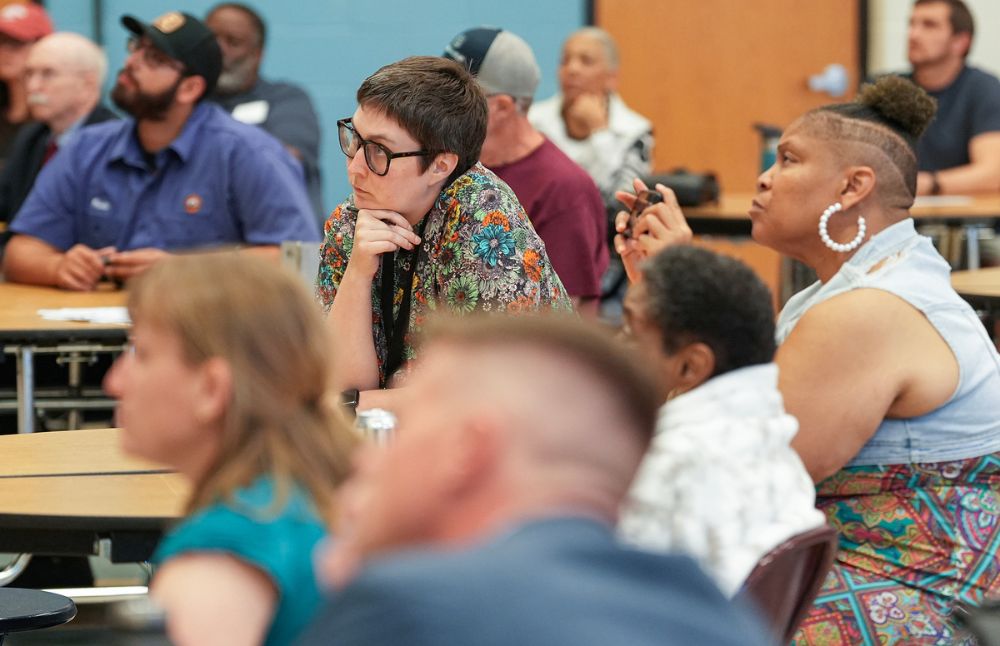
Members of the Mudsock Quilters Guild observe the quilts on display during a meeting at Cornerstone Lutheran Church on July 13, 2026 in Fishers. Credit: Abra Richardson/FPI News
With her trim scissors in hand and her palm gliding across the face of a quilt, Metzger pauses.
“I can’t imagine having to go … identify a loved one. We hope these quilts say that someone cares about you.”
Unseasonably warm weather ensured there’d be no snow on Christmas Day 2023, when Dietrich Gillim and her family gathered to celebrate the holiday. The crew would assemble in the Indianapolis suburb of Fishers, where Roberts still lived in what had been his mom’s house, and the event would be bigger than usual.
Roughly a year earlier, Dietrich Gillim had invited two Ukrainian families to temporarily live with her and Roberts, while the immigrants waited for more permanent housing arrangements to materialize.
To repay their hosts for their generosity, the Ukrainians insisted they take charge of Christmas.
It was a feast.
But Roberts hadn’t felt well that day. Though he’d joined in the meal, he hadn’t stayed long, instead retreating to his basement bedroom to lie down.
For years, Roberts, who was autistic, had navigated a triple-threat of anxiety, Crohn’s disease, and a rare skin disease — pyoderma gangrenosum — characterized by rapidly growing, painful ulcers. What’s more, his dad had been diagnosed with early-onset Alzheimer’s, a feckless beast of a disease affecting not just the afflicted, but the family as well.
To manage his physical and emotional health needs, Roberts had developed a system utilizing not only prescription medication, but by using delta-8 THC and delta-9 THC products, which are legal in Indiana.
When he went to rest, Dietrich Gillim trusted that if he needed help, her son would ask for it. She’d recalled a conversation the pair had just before Christmas, where Roberts encouraged his mom not to worry so much about him. Roberts had a job at Goodwill, was heading to college to study cybersecurity and was busily upgrading his musical skills, teaching himself to play piano.
Roberts asked his mom to trust him — she wanted to honor that request.

So before leaving that night, to head to her new home in Sheridan, Dietrich Gillim sent her son a text, reminding him that she loved him, and that if he felt up to it, to take the garbage out for the morning’s pickup.
Ring cameras later revealed Roberts hauling the trash bins to the curb.
The next morning, Dietrich Gillim waited to reach out to Roberts, thinking he was either still asleep or he’d gone to work. A few hours later, after she still hadn’t heard from him, she had the Ukrainians staying at the house check on him.
“The translation tool they used said, ‘Needs ambulance. He has blood in his mouth,’” she said.
She immediately got in her car. But before she arrived, her phone rang. It was the Fishers police.
“I just kept asking, ‘Is he OK? Is he alive?’ And (the officer) said, ‘We’ll talk when you get here.’”
The police wouldn’t say it over the phone.
Roberts was dead.
A gunshot to the head.
Probably self-inflicted.
“I said, ‘That can’t be right. That can’t be right. It doesn’t make any sense.’”
Since her son’s death, she has done exhaustive research, learning that the U.S. Food & Drug Administration warns consumers — and now Dietrich Gillim wants more families to be aware of the dangers — of “serious health risks” of delta-8 poisoning, including psychoactive side effects.
Roberts owned a gun he used for recreational target shooting. Dietrich Gillim said her son had been well trained in the proper care, handling and storage of a weapon. But somehow, that night, something went horribly, horribly wrong.
A mother was on her way to identify her son at the county morgue.
The handmade black-and-white patterned quilt is one of the few things Dietrich Gillim remembers about identifying her son at the morgue. Because of her son’s injury, the coroner’s staff had strategically positioned the quilt to minimize what his mom would see.

“I could see (the upper part) of his face and his hair, and everything else was the quilt,” she said. “I remember when I saw the quilt, I just thought that at least he was wrapped in something soft, like you would with a baby blanket. If it had just been some sheet, I think it would have reminded me of some kind of CSI movie, but you know … this was my baby. I would have hated that.”
Instead, she said, that final terrible moment was mercifully softened. The coroner’s staff did all they could to reduce the impact of that identification process by washing her son’s face and hair.
And someone she’s never met donated a quilt.
“I have to live many years, the rest of my life, without Sam being here in the physical sense. So at least my last visual was eased, if you can call it that, of it not being a harsh vision of him.”
Dietrich Gillim said the quilt is exactly one her son would have picked out.
She still watches a video of her son playing the piano or looks at old family photos to remember him, but sometimes, she sits and holds the quilt, running her fingers over the patterned fabric, thinking about who made it.
“I’m sure that someone was stitching this because they care. Maybe they were doing it together in a group, having conversations, having laughter and joy,” Dietrich Gillim said. “That’s the way life should be. The happy and the sad.”
Life is temporary, but love is forever, Dietrich Gillim said.
“Sadly, Sam’s life ended way too soon. This wasn’t supposed to happen. But it did. So all I can do is live my life.
“And love him forever.”
To donate quilts to the Hamilton County Coroner, contact the office at (317) 770-4415, or via email at HCCoroner@Hamiltoncounty.in.gov.
To learn more about the Mudsock Quilt Guild visit the club’s website at mudsockquiltersguild.org.
To learn more about delta-8 poisoning, visit the American Poison Centers website.
FPI News, a nonprofit newsroom, is funded through grants and donations from individuals, foundations and organizations. Sign up for our free newsletter.
Lisa Renze is director of strategic partnerships for Free Press Indiana and an FPI News contributor. You can reach her at lisa.renze@freepressindiana.org.