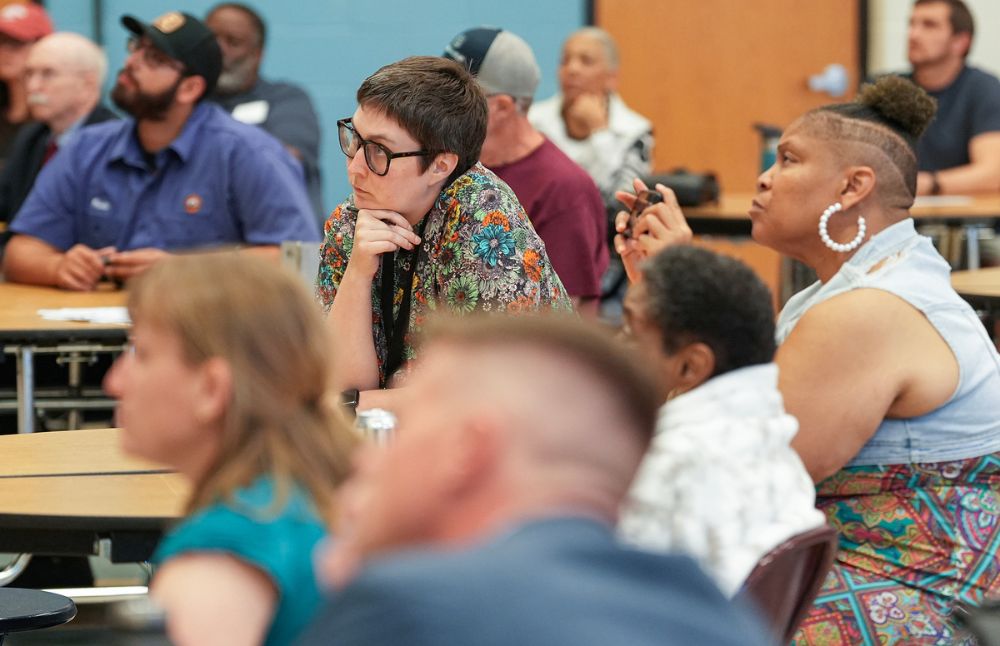
Growing up, DaCarla Mason remembers her mom keeping cash under her bedroom mattress.
Mason, 57, never learned how to invest or save for retirement, so when she started making money of her own, she followed her mother’s practice.
But after taking a course in financial management from a newly formed nonprofit, Mason took that once stagnant pile of cash and made it work for her. She opened a certificate of deposit, which is a specialized type of savings account, where her funds will accrue interest over time.
“I got in this class and I kept hearing about how the money could be making money,” Mason said.
Mason is one of 14 families participating in a free 10-week pilot program put on by Indy Black Wealth, a nonprofit with the goal of increasing Black wealth in Indy to 50% of white wealth by 2040.
A seemingly unlikely figure is leading the effort: Greg Ballard, the former Republican mayor of Indianapolis who is running for secretary of state as a member of the newly formed Lincoln Party.

Ballard, who is white, hasn’t been plugging the initiative on the campaign trail. He’s been working on the nonprofit for the past two years. He said he got the idea after observing that conversations around elevating Black families from poverty centered mostly on income and jobs, rather than building wealth over generations.
“It seems to me people aren’t focused on wealth as its own discipline,” Ballard said. “They talk about upscaling and increasing income, but not as much talk about building wealth.”
Income plays a part in achieving wealth, which is the amount of money, property or valuable possessions owned by an individual. For every $100 in wealth held by white households, Black households hold only $15, according to the Washington, D.C.,-based Brookings Institute. In Marion County, white households make 1.7 times more income than Black families per year, according to the Polis Center at IU Indianapolis.
Past decisions have fed into that, including redlining, the practice of financial lenders of denying mortgages to people living in predominantly Black neighborhoods.
Indianapolis also has a history of displacing Black neighborhoods. In the 1960s, Indiana University acquired 300 acres of land to found IUPUI, driving Black residents out of the area, sometimes through eminent domain, and stagnating Indiana Avenue, a one-time center of commerce for Black people.
The construction of interstate highways broke up ethnic communities across the city, from the southside to Martindale Brightwood to the Old Northside, erasing decades of economic progress — and wealth — earned by minority communities.

‘Reshaping culture’
For the first iteration of the program, Indy Black Wealth partnered with Fervent Prayer Ministries, a Far Eastside church, to offer free classes to some of its congregants at the church.
The church pastor, James Jackson, said he sees the classes as part of an effort at “reshaping culture” in the Black community.
“In Black culture, it’s a fact that money doesn’t stay in the community,” Jackson said. “We tend to be consumers. However, this opens Black folks to something different, and that is investing long-term and building wealth.”
Participants attend 10 classes focused on financial literacy, from building credit and filing taxes to smart investing strategies and planning for retirement.
After completing the curriculum, each participant is given $1,000 that is deposited into a savings account. The money was provided by an anonymous donor.
Financial advisors with Charles Schwab volunteer their time to teach the courses, which also emphasize living beneath your means.
“People jack up their lifestyle as they make more money,” said Rod Willett, managing director with Charles Schwab. “What you want to be doing is making sure that you are putting money away.”

And it isn’t just adults who are learning how to save money.
Shanieta Sease, a financial advisor at Charles Schwab, is teaching children of the participants how to build a portfolio — in terms they can understand.
Six kids on a recent Saturday are gathered around a table as Siese explains how building a diverse portfolio is a lot like growing a garden — a collection of different investments a person owns.
“If you have a garden, and you’re growing tomatoes, fruit, corn — those are different investments a person owns,” Siese explains.

‘One piece of the puzzle’
For others, the solution to building wealth isn’t as simple as squirreling away money or investing in the stock market.
Marshawn Wolley, a Black entrepreneur who has worked on economic and civil rights issues, said those strategies are just “one piece of the puzzle” to bridging the wealth gap between Black and white populations.
“In order to get to wealth, you actually have to deal with the systems that make poverty so expensive,” Wolley said. “They have to get out of payday loans and check cashing systems. They have to get into jobs that pay a livable wage.”
When local influencer Keith “Wildstyle” Paschall got wind of Ballard’s idea, he was skeptical.
But after speaking with Ballard, Paschall said he saw the merits of the initiative.
“Seeing the program is actually more geared towards investing and showing people about the stock market, and also the fact that they’re giving people money instead of saying, theoretically, ‘This is how you invest’ — I think I have a much better opinion of the program,” Paschall said.
Ballard said he’s not worried about skepticism. Before he launched the program, he reached out to several Black community leaders to earn their support. One of those folks was Dennis Bland, president of the Center for Leadership Development.
“He talked about his concerns about the economic station of people. He seemed to be persuaded that he thought he could do something about it,” said Bland, who leads the nonprofit that offers development and leadership programs for inner-city kids. “You don’t get that kind of thought or proposal or proposition everyday, and certainly not from a former mayor.”
Ballard said he was willing to let someone else lead the program if that’s what it took to make it successful.
“I was very open from the very beginning. If someone else had to do it, that would’ve been just fine,” Ballard said. “But they wanted me to do it.”

Bland now serves on the board of the organization, which also includes Tony Mason, president of the Indianapolis Urban League, and Kristie Johnson, vice president of The International Center.
After the pilot program is complete, the board plans to evaluate the results and determine next steps. The group is also seeking donations to fund future cohorts.
Passing down knowledge
Mason knows she can’t undo mistakes she’s made in the past, but she is taking what she learned in the courses and telling her family and friends.
Early in her career, she built up a 401k after working a dozen years in a business management role. She wasn’t aware that she could “roll over” the money into an individual retirement account, so she withdrew the money, which triggers penalties when done before retirement age.
“When I left the job, I pulled the money out and I blew it in six months,” she recalls.
Mason is one of 14 participants who will graduate from the program later this month. She’s planning to take what she learned and pass it on to her children and grandchildren.
“I wish I knew to invest,” Mason said. “This is knowledge that I’m passing on to them.”
Mirror Indy, a nonprofit newsroom, is funded through grants and donations from individuals, foundations and organizations.
Peter Blanchard covers local government. Reach him by phone or Signal at 317-605-4836 or peter.blanchard@mirrorindy.org. Follow him on X @peterlblanchard.