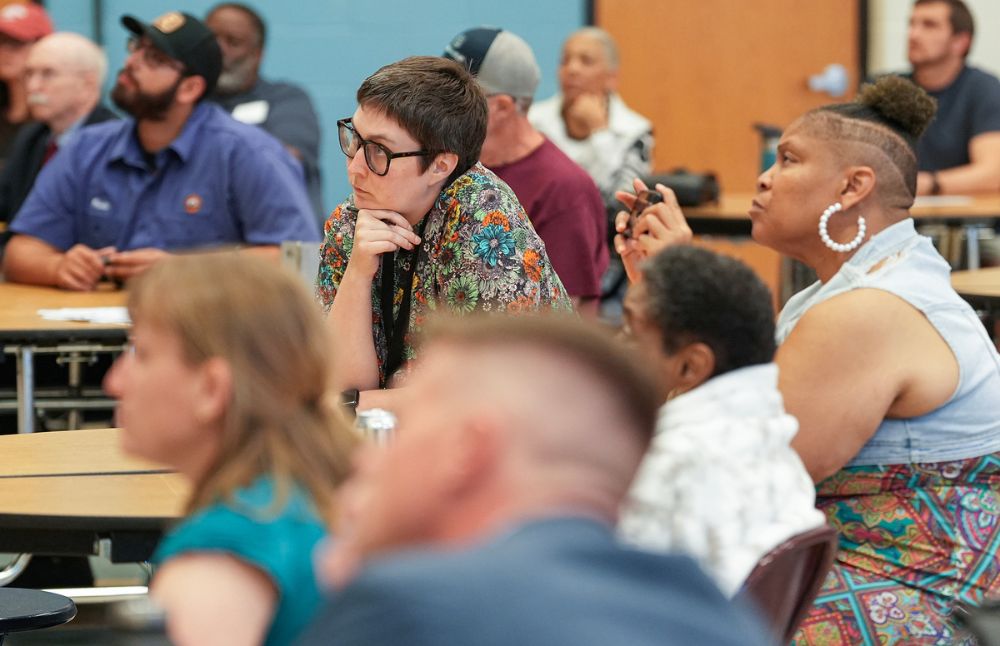
Most candidates for the Indianapolis Public Schools board support the district’s break from the city’s unified student enrollment system, they said at an Oct. 19 forum hosted by WFYI and Chalkbeat Indiana.
Superintendent Aleesia Johnson’s administration decided in September to leave Enroll Indy and run its own enrollment system. Both district and charter schools have used for nine years. The move has drawn criticism from charter school backers and praise from those who want IPS to control how students are enrolled.
Fifteen candidates are running for five seats — one each in Districts 2, 3, 4 and 5 and one at-large seat. Fourteen took part in the forum at Central Library. District 4 candidate Chris Bultman said he had a prior engagement. Early voting is underway ahead of the Nov. 3 election.
At-large incumbent Angelia Moore and District 3 candidate Derek Redelman said they opposed the change. District 5 candidate Yuri Smith Sr. said he somewhat supported it.
District 3 candidate Loren Heger said he is ambivalent on the decision but believes there are cheaper solutions to manage enrollment. IPS has said Enroll Indy costs the district more than $300,000 annually. Heger said he used the artificial intelligence chatbot Claude to create a program in minutes that would cover enrollment for district and charter schools.
“That’s the type of thing that we need to do as a district to try to find solutions that don’t cost hundreds of thousands of dollars for software service — that can be done on a phone in 15 minutes,” he said. “When we see everything as proxy battles between charters and unions, we don’t see those solutions.”
When a moderator asked candidates to answer in one word whether they supported or opposed the change, the other 10 candidates said they supported it.
The divide between charter, IPS supporters
Candidates varied in their responses to how they would bridge the yearslong animosity between district and charter school supporters.
Lindsey Cornett, a candidate for District 4, said she never criticizes a family for choosing a charter school or teachers who work in one. Rather, her concern is with the sustainability of the city’s school system.
“A lot of that vitriol is driven by particular individuals who get on the internet and troll those who disagree with them or who have made different education choices,” Cornett said. “That’s never how I’ve chosen to operate, and it certainly isn’t how I would operate as a board member.”
Smith said many families don’t know the difference between a traditional, Innovation Network or charter school. He stressed the importance of involving the community in conversations.
District 2 candidate Bryan Duarte, backed by groups supportive of traditional IPS schools, argued the city’s educational system is divisive by design. He questioned why school board members have received campaign donations from groups like Stand for Children Indiana and Rise Indy, which have supported changes to IPS.

“If people are sitting on our board that got elected because those groups have paid tens of thousands — maybe even hundreds of thousands of dollars — for their campaigns, do they really represent the interests of IPS?,” he said.
Duarte’s opponent, incumbent board member Hasaan Rashid, said the core focus should be children, regardless of the school type they attend.
“It’s about the education of the kids, making sure that they’re getting the education that they need,” he said. “Doesn’t matter what the school is. We’ve got to get off that discussion.”
At-large candidate Alexander Nyirendah and Heger, a District 3 candidate, argued that the real funding challenge lies between public and private schools. Last school year, the state’s private school voucher program cost $548 million. This school year, a voucher that will help pay for tuition at a religious or private school is available to all families regardless of income.
“We’re over here fighting for peanuts amongst ourselves while the wealthier are getting vouchers for their summer vacations,” Nyirendah said.
Candidate thoughts on framework for school closures
The nine-member, mayor-appointed board — Indianapolis Public Education Corporation, created by state law earlier this year — will control buildings and transportation for IPS and charter schools in 2028. It must also create a school rating system for both district and charter schools that could inform potential school closures.
Rashid said the district should ensure that students at schools that close will still be able to get the same services at their new school. His opponent, Duarte, argued that the district should look at alternatives to school closures.

“My question would be, what does the community want and need?” said Nicole Carey, District 5 incumbent. “There are many examples of different industries like nursing homes. You can’t just open a new nursing home if there’s not a community need.”
District 3 candidate Daqavise Winston said the district needs to look at who is enrolled at a school facing closure and understand who will be affected.
“What is the next closest location for those families?” he said.
Incumbents Moore, at large, and Hope Duke Star, District 5, noted the need to assess building condition and usage.
“We have to think about building usage. All of those things do matter,” Star said, adding that the district must be fiscally responsible. “People say that they don’t, but when you walk into an empty building, it does matter.”
Candidates split on AI in schools
Smith said there are more dire situations in the district than the use of artificial intelligence, such as ensuring that students can read.

But Carey argued that the district should focus on the quickly evolving technology.
“The world is evolving. We’re not going to be able to ignore it,” Carey said. “It is important for us to have really strong policies.”
In the District 3 race, Heger said he does not think there’s a role for AI in education.
“I’m sure students are using it, but we shouldn’t be advocating the use of it in any capacity as an educational organization,” he said.
Redelman, a District 3 candidate, said the district should make sure that students are understanding it and using it responsibly while still learning content knowledge.
Candidates want more support from legislature
Most candidates said they want the Indiana General Assembly to provide more funding for schools, particularly for special education. IPS estimates a gap of $24 million between the state and federal funds it receives for special education and the cost of those services.
But Redelman, who has worked with lawmakers on education legislation, said district leaders need to be less hostile toward the legislature.
“If all we’re doing is going to the legislature and saying ‘We need more money,’ it’s going to fall flat,” he said. “I think what they’d like to hear instead is, ‘Okay, how can we help you do better with the money that you have?’”
Independent candidates say they want partisan politics out of race
The election is the first for partisan school board candidates in Indiana. Twelve candidates are running as Democrats, and Cornett is an unaffiliated candidate after a successful challenge to her party affiliation.
At-large candidate Heather Houston and Redelman are both running as independents. Voting records show that Houston has voted in Democratic primaries and Redelman in Republican primaries.
But both said they ran as independents because they don’t believe the race should be partisan.
Election Day is Tuesday, Nov. 3.
Correction: District 4 candidate Lindsey Cornett is an unaffiliated candidate on the ballot, she is not a write-in candidate.
This article was written by Amelia Pak-Harvey for WFYI.