One of the most common sights to see around Indianapolis are the bright orange of traffic cones and barrels.
City crews and contractors are working on major projects, like the 16th Street Bridge repair, that the city has said will make residents’ commutes safer, or the IndyGo Blue Line construction along Washington Street, which will eventually improve travel to and from the Indianapolis International Airport.
Even with that work underway, a quick drive through almost any part of the city reveals that many streets are cratered with potholes or in need of other repairs. And Indianapolis has been struggling to pay to repave roads for ages.
Recent state-level changes to property taxes are crunching budgets at local governments throughout the state even further, making it more difficult to fund things like road improvements everywhere. As a result of that state legislation, Indianapolis is expected to lose $10 million in property tax revenue this year, about $20 million in 2027 and about $30 million in 2028.

The General Assembly, which is controlled by Republicans, did offer a solution. Lawmakers have given Indianapolis the opportunity to access $50 million in road funding per year if Indianapolis can raise at least that amount annually.
City-County Councilor Andy Nielsen, a Democrat who represents parts of the east side, has introduced a proposal to raise much of the money by increasing the amount people pay in county vehicle taxes every year. It’s initially supported by 13 councilors, a majority, and would raise about $71 million dollars a year in revenue.
The price tag would be a hefty increase for motorists. Some people paying the county minimum of $7.50 a year would end up paying $100 for each vehicle they own.
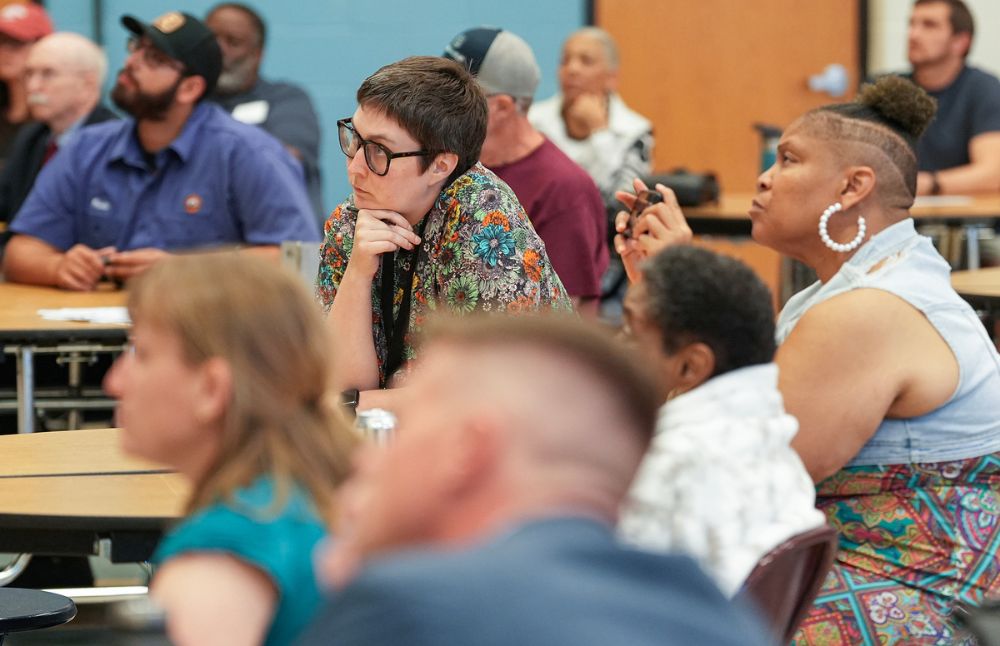
At the June 11 Public Works Committee hearing at the Pike Township Government Building, city-county councilors and dozens of city residents had a chance to say what they thought about the bill and how it could affect Indianapolis residents.
Not everyone is in support. City-County Councilor Crista Lee Wells, a Democrat who represents parts of the west side, said the tax increase would be a burden on her constituents.
“I think it hurts small businesses. I think it hurts families and low-income individuals specifically,” said Wells. “I represent a lot of those demographic individuals and families that I just mentioned, and I feel to support this would be a disservice to them.”

Mayor Joe Hogsett, also a Democrat, is floating a different proposal to fund the match without raising taxes.
“We owe it to our community members to deliver solutions that invest in infrastructure without placing additional financial strain on hardworking families,” Hogsett said in a May statement. “It is my firm belief that the proposal presented is not that solution.”
But Nielsen wonders whether the city budget can absorb that cost. Nielsen said his proposal is necessary to ensure that the city can afford to fix its roads without cutting services that people depend on.
“Without additional dedicated road revenue, the city may need to make difficult trade-offs with basic services and other community priorities,” he said. “Delaying investment does not stop infrastructure from aging. It can make future maintenance, rehabilitation, or replacement more costly.”
How the tax increase would work
The proposal would make the county’s annual excise tax a flat fee of $100 for all vehicles.
The current excise tax is a formula that takes into account vehicle type, price and age. Under the current county excise tax, the most people pay the county annually for a passenger vehicle is about $53 for a new vehicle with a price tag above $42,500. It’s $237.50 for a new recreational vehicle.
The owners of older vehicles, motorcycles and trailers pay the minimum $7.50.
“For me, I think the increase would be like $850-$900 bucks every year, at least. And I drive 15-to-20-year-old cars every day. I don’t have anything new, and I do that to save money on taxes. And now you guys are asking for more,” eastside resident CJ Noiseux told committee members.

The proposal would also increase the wheel tax for vehicles heavier than 11,000 pounds, like large trucks, buses and semitrailers, to a flat fee of $240.
“These are obviously the vehicles that are doing the most damage to the streets, and they have been paying less than passenger vehicles have been paying,” Nielsen said.
Heavy vehicles that are currently exempt from the wheel tax, like school buses and fire trucks, would still be exempt under the proposal.
How does the state match work?
Earlier this year, the state passed Senate Bill 179, which increases the amount of money Indianapolis is required to provide in order to tap into the matching funds every year.
In the first year of participation, the city would have to provide $50 million to receive $50 million.
In the second year, the city would have to provide $70 million and would receive $50 million.
From there, the amount the city would have to raise to tap into the state money would rise $10 million every year until it hit $100 million in the fifth year of participation. The state would still only match the first $50 million.

The deal also ends if the city participates and then cannot raise the required amounts in future years. The city would not be able to tap into those funds again.
“The first year that we are unable to make the match, unless there’s a change in state law, we don’t get (the matching state money). So, if we match in ‘27 and ‘28 and come up a little bit short in ‘29, we don’t get to come back and get that money,” Nielsen said.
That concerned several council members, who noted Nielsen’s proposal would raise $71 million. They asked where the remaining money would come from to get to $80 million, $90 million and eventually $100 million.
Nielsen said coming up with the rest of the money would require finding “efficiencies” in the city budget.
What’s Hogsett’s proposal?
Aliya Wishner, the city’s communications and policy director, said Hogsett’s plan to raise the $50 million does not require a tax increase.
Instead, the money would come from $10 million already allocated in the 2026 budget, another $10 million allocated in the 2027 budget, $5 million from stormwater fees and $25 million allocated through a 2027 spring fiscal ordinance.
“In future years, the city will use funding from budget efficiencies and growth to meet the additional required matching dollars,” Wishner said in an email. “This administration has time and time again continued to increase road funding and at the same time receive the highest credit ratings from three out of four ratings agencies.”
Nielsen told the committee that reduced gas tax revenues, which the city also relies upon for funding, could put Hogsett’s plan at risk. Nielsen is worried other city services could be cut if the council doesn’t find new revenue.

“If we were to play this year out… we would be making quick cuts in order to meet the match,” he said. “That’s not a sustainable point, and I think that that poses a series of cascading risks that I don’t think that we’re prepared for.”
Several council members said infrastructure issues are one of the main topics their constituents contact them about. But some disagreed that raising taxes was the best way to address that issue.
“Everything’s expensive right now, and my constituency — being working class and seniors — I don’t know how they can afford this. I don’t know how they can take that hit of $100 more in fees or $240 for heavy equipment,” said City-County Councilor Ron Gibson, a Democrat who represents Martindale Brightwood and other portions of the east side.
Next steps
The proposal will be up for a committee vote at the Rules & Public Policy Committee hearing on June 16.
That hearing will include an opportunity for public comment and will take place at 5:30 p.m. at the Ivy Tech Community College, Illinois Fall Creek Building, 2535 N. Capitol Ave. The meeting will not be streamed live, but a recording of the meeting will be posted online.
If the committee votes to recommend the proposal, it will then be considered by the full City-County Council July 6.
To find the contact information for your councilor, click on their name at this website.
This story was updated June 16: The story has been updated with the current location for the June 16 Rules & Committee hearing.
Mirror Indy, a nonprofit newsroom, is funded through grants and donations from individuals, foundations and organizations. Sign up for our free newsletters.
Mirror Indy reporter Enrique Saenz covers west Indianapolis. Contact him at 317-983-4203 or enrique.saenz@mirrorindy.org. Follow him on Bluesky at @enriquesaenz.bsky.social.