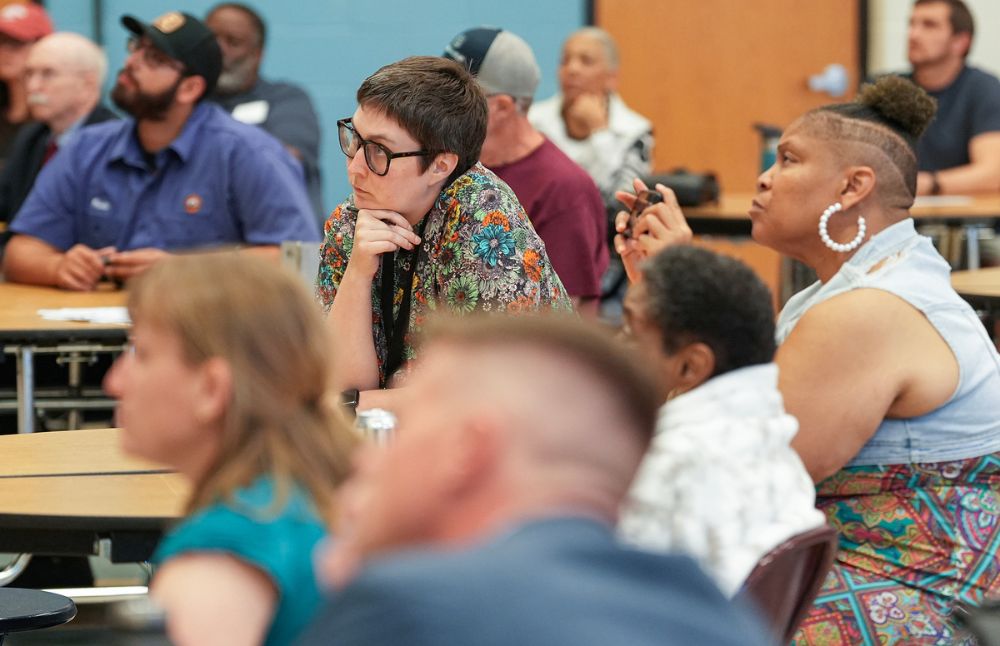
When Martin University closed last year, the community mourned the loss of Indiana’s only predominantly Black college.
I spent some time this spring at alumni gatherings, listening to people talk about what Martin University meant to them, to their families and to the community since 1977.
At one of those events, former Martin professor and alum Clete Ladd mentioned that Martin was not Indiana’s first Black college. It was actually Lewis Business College, a secretarial school founded for Black women just off Indiana Avenue in the late 1920s.
I’d never heard of Lewis, so I decided to do some research. I learned all about the school and the woman who founded it, Violet Temple Lewis.
Here’s her story:
By a Black woman, for Black women
Lewis was born in Lima, Ohio in 1897. After graduating high school, she went on to complete the secretarial program at Wilberforce University in Ohio, the nation’s first private HBCU, and graduated in 1917.
Her education was a major accomplishment for the time: Lewis was one of just 2,132 Black Americans enrolled in college in 1917, according to an article in the academic journal Sociology Mind.
After a short stint at Selma University in Alabama, she moved to Indianapolis and got a job as a bookkeeper at the Madam C.J. Walker Company and then at the Indianapolis Recorder.
While working in Indy, Lewis noticed that there weren’t many Black women working as secretaries, according to the Indy Encyclopedia. She vowed to change that.

Sea Ferguson — the successful Indiana Avenue businessman who Lewis was working for at the time — offered Lewis three months free rent in a vacant storefront at 246 W. Vermont Street downtown for her school.
Lewis opened her new school in early 1929, with “$50 in cash and a secondhand typewriter,” according to the Indianapolis Recorder.
Women enrolled to learn skills such as typewriting, shorthand and bookkeeping. An eighth grade education was required, according to Indianapolis Times archives.
In August 1929, the school held its first commencement ceremony where five women graduated, according to Indianapolis Recorder archives.
The college was always a relatively small operation in Indy. A decade after it opened, Lewis had “regular daily attendance” of 29 students, per Recorder archives.
The Indy years
Though Lewis had passion and drive, starting a school from scratch was difficult.
For several years, business students took classes at a location up on 28th Street, where Lewis added dorms for out-of-state students, according to Indianapolis Recorder archives.
In an effort to get more students, Lewis also started her own radio show, “The Negro Melody Hour,” which was sponsored by the college.
One advertisement for the program from November 1932 boasted music from a local church choir as well as the Four Harmony Kings, a gospel and blues group. That made Lewis the first Black woman to work as a radio announcer in Indiana, according to Indy Encyclopedia.
Lewis moved the school back down to 453 Indiana Avenue in 1936. The expanded school included more amenities such as a type shop and an employment bureau for Black residents looking for careers, according to the Indianapolis Recorder.

In 1939, Lewis decided to expand the college’s footprint to Detroit, a city with a large Black population. That location was met with success “much more rapidly” than in Indy, per Indianapolis Recorder archives.
Because the Detroit school grew so fast, Lewis decided to close the Indianapolis college in 1941.
“It takes so much of my time and capacity to properly carry on in this city, that I find it difficult to continue in Indianapolis,” Lewis wrote in an editorial in the Indianapolis Recorder. “I had hoped that I would find some other person interested in the Business School work, who would like to carry on in Indianapolis, but to this date have not.”
The school’s legacy
There was high demand among Black Detroiters to get trained in business and get to work. The city’s thriving automobile industry — and Detroit’s role in producing arms and vessels for World War II — there were jobs to be had.
In a 1943 edition of the Michigan Chronicle — Detroit’s Black newspaper — an ad for Lewis Business College urged Detroiters to enroll in order to better both the United States’ future and their own.
“We will be the greatest benefactors of an Allied victory,” the ad read. “Unless we are trained and efficient, we can not hold the advantage won now during the post-war period.”
The school eventually changed its name to Lewis College of Business and was officially designated as an HBCU in 1987, nearly 20 years after Lewis died in 1968. Her daughters took over running the school after her death.
But as Detroit experienced an economic crisis in the 1990s and early 2000s, the college struggled. The school lost its accreditation in 2007 and closed in 2013.
As of 2011, over 2,500 students had graduated from the college during its 70-year history in Detroit, according to a now-archived version of the college’s website.
In 2021, shoe designer D’Wayne Edwards announced he’d reopen Lewis College of Business in Detroit and change the name to Pensole Lewis College of Business and Design, a business college with an emphasis on sneaker design.
Pensole Lewis College started offering classes in 2022 and was the first HBCU to reopen after closing its doors.
Today, the school offers masterclasses in partnership with companies, certificate programs and associate degrees in design, according to the website.
Mirror Indy, a nonprofit newsroom, is funded through grants and donations from individuals, foundations and organizations. Sign up for our free newsletters.
Claire Rafford covers higher education for Mirror Indy in partnership with Open Campus. Contact Claire by email claire.rafford@mirrorindy.org, at 317-759-0249 or on most social media @clairerafford.