When you step into a church, school or city building to vote on primary Election Day, a poll worker will greet you. It’s their job to keep elections running smoothly and securely.
But how do poll workers learn how to start up a vote machine? Or what to do when a voter forgets their ID or walks in with a T-shirt promoting a candidate?
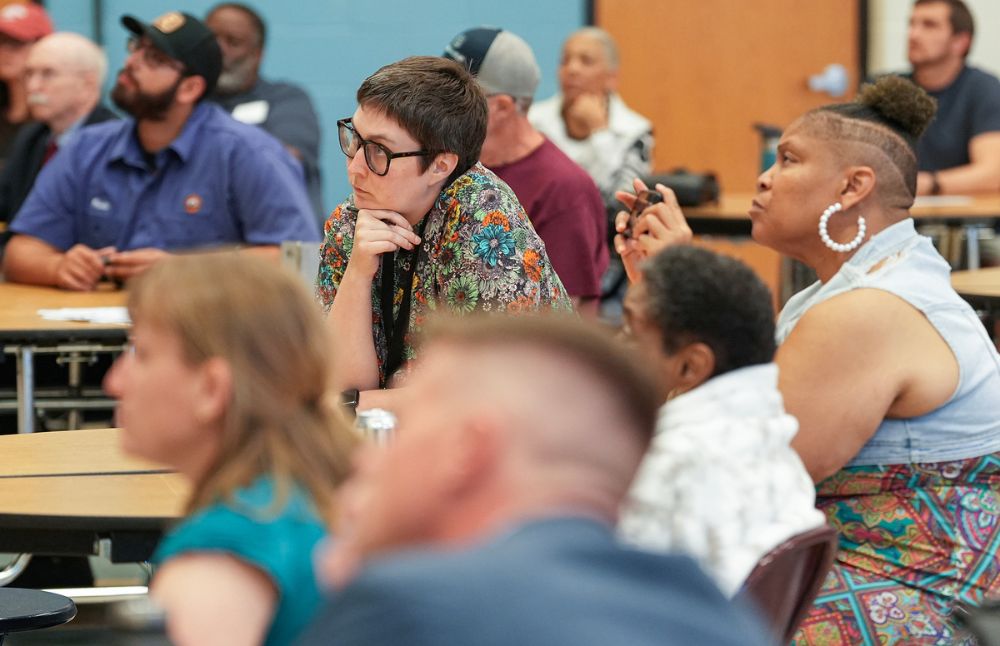
I wanted to learn how elections are run, from behind the scenes. So I attended an April 15 training session for inspectors, the poll workers who are in charge of running each polling place in Marion County.
There are three types of poll workers. You can be a student poll worker, a clerk or an inspector. Inspectors are typically more experienced. They’re the go-to people for any issues that come up.
Inspectors earn $240 to work from 6 a.m. to 6 p.m. on election days, and ahead of every election they’re required to take the two-hour training that I did at the Marion County Election Board Service Center. At the end, they sign an oath that they will abide by election law.

When I walked into the two-hour training, I picked up a folder with a 33-page resource guide that walks through almost every scenario that can happen on Election Day and a checklist of 46 things to do throughout the day. Each person sat down in front of a neon green box that contained a Poll Pad, the iPad clerks use to check voters’ registrations and IDs on Election Day.
A practice round before Election Day
For the first 90 minutes, we listened as Shannon Samson, a project manager at the Marion County Election Board, explained what to know about running a vote center.
The others asked questions about how to handle situations they had faced in previous elections. The Rev. Dr. William Rowe, who is heading into his fourth election as a poll worker, said the voter registration records had accidentally merged a pair of twins who came to vote in 2024, because they had similar names, birthdays and addresses. Samson told him to call her on Election Day if that happened again, and she’d get it sorted out. Poll workers can use a specific hotline to call the Marion County Election Board.

In the last half hour of training, we practiced setting up machines. That included the Poll Pad and the ExpressVote, the machine you feed your ballot into and make your choices on. Last, they set up the machine that counts votes.
I tried to set up the iPad and the printer that puts barcodes on ballots, but stopped to watch the more experienced folks zoom through it and then help others figure it out.
For inspectors, Election Day starts at 5 a.m.
During primary Election Day on May 5, these inspectors will use everything they learned at training. Each one will show up at the polling place they’re in charge of at 5 a.m. They have to be prepared with a big box of election supplies and all their snacks and drinks for the day.
They’ll set up folding tables, prepare the Poll Pad and start up the voting machines. Every machine is closed and sealed with a zip tie. Inspectors use wirecutters to break the seal on the morning of Election Day.
They stay until the last voter leaves, after polls close at 6 p.m. Every voter will have to take their ballot from the ExpressVote and put it into a machine that looks like a big trash can. It’s called a DS200, and it reads the paper ballots and saves all the vote tallies onto a tiny flash drive in a locked compartment.
At the end of the day, the poll workers rip a seal off the machine, unlock it and take out the flash drive. The DS200 prints out a roll of tape that looks like a very long CVS receipt. It’s called totals tape because it shows the total number of votes for each candidate. The poll workers count the number of paper ballots by hand to make sure the total matches the number of voters checked and the votes on the totals tape.
A Democrat and Republican take the flash drive that’s labeled “don’t forget me” to one of four regional centers in Marion County, where election board staff total up the vote tallies and get the results.

How you can be a poll worker
There are three types of poll workers: student poll workers, clerks and inspectors.
Clerks greet you when you walk into a vote center, check you in and can help you with the vote machine. They aren’t required to go to training, but they are strongly encouraged to. They can earn up to $180 a day. Student poll workers do the same duties and get paid the same amount. They have to be at least 16, have a 3.0 GPA and get permission from a parent and school official.
Inspectors run vote centers, have to do two hours of training and earn $240.
To be eligible to serve as a poll worker in Marion County, you have to:
- Be registered to vote, unless you’re a high school poll worker.
- Have reliable transportation.
- Work a full day on Election Day as an inspector. Clerks can work half or full days.
You can sign up to be a poll worker up until Election Day on May 5. In Marion County, the Election Board typically has fewer Republicans sign up to be poll workers.
Be nice when you’re tired, and other tips from seasoned poll workers
Alice Steppe, 70, has been a poll worker for about 35 years. When I asked her why, she started tearing up while talking about the importance of democracy.
“I wish more people were educated about all the things we do and have improved to keep it safe,” she said. “It’s your privilege. Election Day’s about the voters, it’s not about parties. It’s for each individual citizen. I wish more Hoosiers would take advantage of that.”
Steppe’s tips for first-time poll workers:
- “Bring a stash of your own food, snacks, drinks.”
- “Be hospitable even when you’re tired.”
- “Be positive with each other and patient.”

Nicole Owens, 48, has worked elections since 2020.
“It’s fun, it’s interesting,” she said. “You get to learn a lot about how elections work.”
Owens’ tips for first time poll workers:
- “Don’t come in with any expectations,” she said. “I would say — regardless of how you feel as far as what your beliefs are, as far as your selections — don’t be combative with that. Everybody is entitled to vote how they want to vote. So I would say be mindful of that.”
The Rev. Dr. William Rowe, 65, is a precinct committeeperson in Warren Township.
Rowe’s tips:
- The most intimidating part of the training is learning how to set up vote machines, but referring to the training guides is helpful. “As long as you take what they gave us today and you go over it before Election Day, you’ll keep it in your mind so when that situation comes up, you’ll know what to do,” he said.
- Don’t be afraid to call the Marion County Election Board hotline. “If you have a question or don’t remember something, give them a call and they’ll help you with whatever issues you might have,” he said.
A correction was made on April 17, 2026: An earlier version of this article did not state the correct type of poll worker who checks voters in at polling places. Clerks do that.
Mirror Indy, a nonprofit newsroom, is funded through grants and donations from individuals, foundations and organizations. Sign up for our free newsletters.
Mirror Indy reporter Sophie Young covers services and resources. Contact her at sophie.young@mirrorindy.org.