Do you have experience working for or interacting with IMPD or other Marion County police departments?
We want to hear from you. Contact Senior Reporter Emily Hopkins:
Email: emily.hopkins@mirrorindy.org
Cell/Signal: 317-790-5268
The cafe in Hershyville offers a one-of-a-kind experience.
Step inside and a bearded man behind the counter will hand you a gun and a holster.
This is no ordinary cafe, after all. It’s part of a scenario village where Indianapolis Metropolitan Police Department officers are trained on real-life scenarios before they hit the streets.

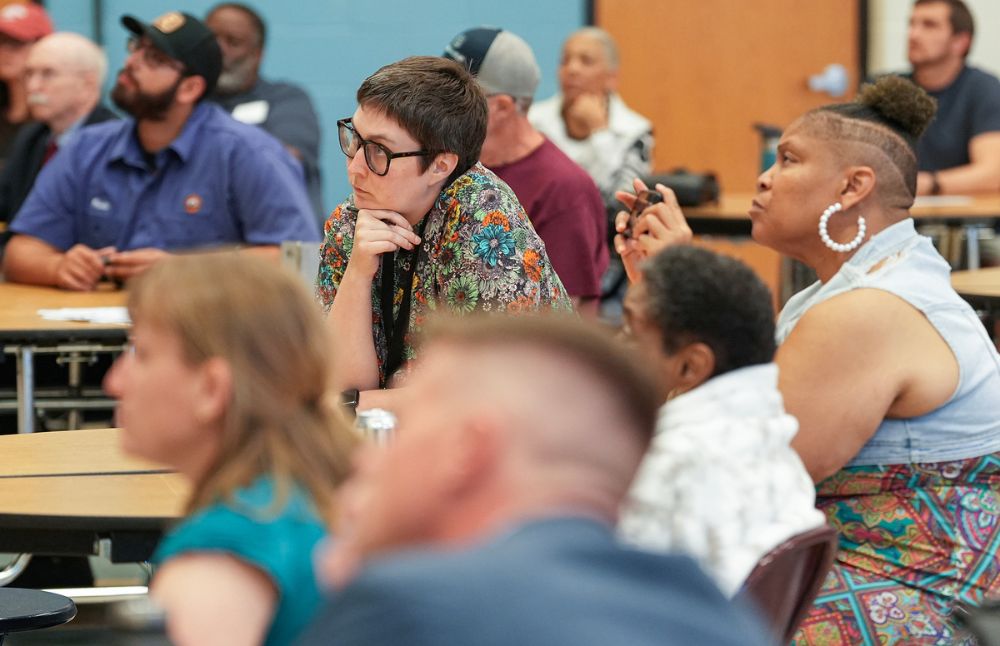
I was one of a few journalists and several community members to participate in an abbreviated version of IMPD’s training regime. The goal of the session was to have us walk away with a better understanding of the difficult decisions officers make when attempting to de-escalate or use force against potentially armed people.
But my goal also was to better understand what officers are doing to avoid deadly police shootings — and whether that’s enough.
We spent the first half in the classroom going over the legal frameworks that translate into training and policies. Then we hit the streets to test our ability to navigate a variety of scenarios that can turn deadly in a matter of seconds.
The first call came from a man whose roommate, Josh, was wielding a machete. I paired up with Mary Dicken, a pastor and executive director of the Broad Ripple Village Association. Dedicated to anti-violence, Dicken chose to forgo the mock weapons on our call.

“It’s a line I don’t cross,” she said.
The encounter lasted probably less than two minutes. We spoke to Josh’s roommate, who told us that Josh takes medication and sometimes has hospital stays related to mental illness. Josh came down the stairs, machete in hand.
I drew my “weapon.” Luckily, I didn’t “need” it.
It quickly became clear that while Josh was experiencing some kind of episode, he wasn’t a danger to himself or others. Mary and I tried to calm Josh down while getting more information from the roommate.
We ushered the roommate outside, and the scene ended.

The next scenario was much more intense. This time I paired up with Dan Cicchini, chief deputy prosecutor of the Marion County Prosecutor’s Office. We made a plan — he would take the lead, and I’d be back up.
That plan immediately went out the window. We were each placed in separate IMPD vehicles and couldn’t see each other as we “responded” to a traffic stop of unknown risk. The interaction also probably lasted less than two minutes. In that time, the passenger of an SUV started shouting at us, and then the driver started pointing a “gun” at us and shooting.
I fired a few rounds from my “gun”; the assailant fell, and the scene was over. The experience was surreal. I felt a bit outside my body, like what had just happened wasn’t real, or like I was watching it rather than participating.
We completed two more exercises: a domestic violence call, and reports of a man firing a weapon on the streets.
My biggest takeaway: I don’t envy anyone who ends up in these situations. The scenarios, based on real situations IMPD officers have encountered, encompassed dangerous and deadly days on the job for officers. They also highlight some of the worst moments in people’s lives, where for whatever reason they’ve resorted to violence.

The experience also left me with a question: What are the levers we can, as a society, pull to avoid these situations altogether? The solutions clearly lie beyond how police are trained and operate. I’ll be thinking about this question for a long time, especially as Mirror Indy thinks about how to cover policing and public safety in the future.
At the top of the night, we were told that IMPD was not trying to persuade us with this experience. Toward the end, I asked a few participants whether they felt like they were being persuaded.
“There’s definitely an agenda,” one observed.
I did walk away with some more practical information on how use of force is supposed to work. Here are some other takeaways:
What’s allowed on the streets is decided in courtrooms
The foundations of how police use force comes from the Fourth Amendment of the constitution, which protects citizens from unreasonable search and seizure. Force is considered the seizure in this instance.
The U.S. Supreme Court has weighed in on how to test what’s reasonable or not. The landmark case Graham v. Connor requires officers to weigh how to use force against the government’s need to subdue a person.

Factors that come into play include the officer’s experience, the availability of backup and the number of suspects. The difference in size, age of the person and known effects of drugs and alcohol also come into play.
Officers would also consider the duration of the incident, availability of weapons, status of potential victims, known effects, whether the officer knows a person is likely to become violent. Those factors are weighed against the severity of the suspected crime, whether there is an immediate threat to the public and whether the person is resisting by fighting or running away.
De-escalation sometimes gets physical
There are many de-escalation tactics that don’t involve physical contact. But Sgt. Jason Groce said that physical contact is also considered de-escalation.
“If somebody’s coming at me, or we’re in a physical confrontation, if I hit them and they go unconscious, I technically just de-escalated them,” he said. “People don’t like to say that’s the truth, but that’s the truth.”

Even so, Groce said that police have over time adopted strategies to avoid violent confrontations. Creating space and barriers between an officer and a person is one way to do that, he said.
Officers have also moved from an “ask them, tell them, make them” procedure to a more expansive, “ask them, tell them why, give them options” procedure.
Toward the end of that second process, Groce would try to confirm the individual’s choices with the goal that they will walk away.
“‘So what you’re telling me is, you would rather go to jail, lose a day’s work, possibly get fired,’” he’d say. “Whatever I can think of at this point, because I just want to leave. I don’t want a physical confrontation.”
Deadly use of force is justified by state law
As of July 2024, state law standardized the deadly use of force policy for all police departments in Indiana.
That law says that a law enforcement officer is justified in using deadly force if there is probable cause that deadly force would prevent the commission of a forcible felony.
A forcible felony involves the use or threat of force against a human being, or the threat of imminent danger of injury to a human being.

Officers are also justified to use deadly force to stop a person the officer believes poses a threat of serious bodily injury to the officer or a third person.
In either case the officer must give a warning, if feasible.
Additional information about how IMPD officers are expected to use force can be found in their general orders.
Do you feel your community is over policed, under policed or policed just right? Come talk to us about it at our next Chat N Chew, noon to 1:30 p.m., Wednesday, Aug. 5 at The AMP at 16 Tech, 1220 Waterway Blvd.
Bring (or buy) your lunch and join Claire Rafford, higher education reporter, and Peter Blanchard, government reporter, as we make space for you to share your experience or concerns with local law enforcement.

Want to keep up with IMPD? Indy Documenters often cover these meetings. 📝 Read their notes.
Mirror Indy, a nonprofit newsroom, is funded through grants and donations from individuals, foundations and organizations. Sign up for our free newsletters.
Emily Hopkins is a senior reporter at Mirror Indy. You can reach them by phone or Signal at 317-790-5268 or email at emily.hopkins@mirrorindy.org. Follow them on most social media @indyemapolis or on Bluesky @emilyhopkins.bsky.social.