Anyone “adulting” in this world knows that paperwork is part of life — bills, school forms, W-9s and other such documents.
Artist Gloria Martinez-Granados sees all these papers as a way to tell the story of her life as an immigrant. Her documents include work authorization cards and other government forms associated with her citizenship status. With them, Martinez-Granados created an art piece that hangs from the ceiling of a gallery. People can walk through for a close-up look.
“It captures the obstacles I’ve faced in trying to belong and trying to understand this system in which I’m in limbo because of my DACA status,” she said.
What is DACA?
DACA is short for Deferred Action for Childhood Arrivals, which protects immigrants who arrived in the U.S. as children from removal action. It does not provide a pathway to U.S. citizenship. People protected by DACA are also known as “DREAMers.”
The exhibition is one of three by three artists — hence the title “3 by 3” — that opens with a reception Wednesday, June 26, 6-8 p.m. at Herron School of Art and Design, 735 W New York St., and can be seen through Aug. 10.

Sometimes a painting can’t tell a full story.
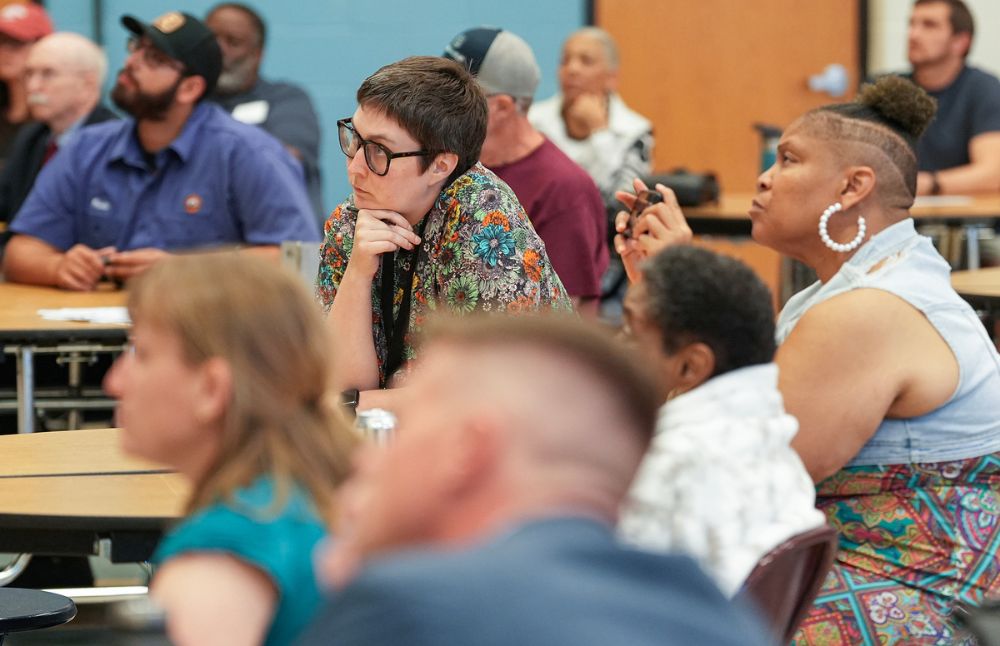
On a recent Friday night, Martinez-Granados took a break from hanging documents from the ceiling inside the Herron galleries to lead a paper-weaving workshop at the Indianapolis Liberation Center.
Because of its focus on the immigrant community, the workshop was done in partnership with the Indiana Undocumented Youth Alliance and Arte Mexicano en Indianapolis. Martinez-Granado invited attendees to write their personal or family experiences with the immigration system on a sheet of color paper, creating an original document told in the terms of the writer.
The paper was then cut into strips and weaved in a checkered pattern where only some of the words were visible.
“These are personal stories. I wanted to give them the power to share but also feel protected,” said Martinez-Granados, who is based in Phoenix. “While my work is not directly tied to Indiana, it is in the ways that state policies spread nationwide. These documents create supremacy and control the lives of immigrants.”

“3 by 3,” besides referring to three artists, also means three curators. Herron galleries manager Elias Garza Garcia is the curator who invited Martinez-Granados to be part of the exhibition.
What is a curator?
In a museum or art gallery, a curator is the person who organizes and manages an art exhibition.
“I followed her for a very long time on Instagram,” he said. “I’ve been a really big fan of her work because I, myself, am on DACA.”
Garza Garcia arrived in the U.S. when he was 8 years old. Seeing an artist who speaks so openly about her struggles and identity as an undocumented person made a big impact on him. “I just feel very connected. A lot of her own personal life reflects mine.”
The fact that a curator understands her as an artist makes Martinez-Granados feel like her story is in safe hands.
“Sometimes it’s challenging when you meet someone that doesn’t share those experiences as an artist. It can change how your work is treated or seen,” she said.
Unicorns and Afrofuturism. Puppets and embarrassment.
Garza Garcia said he doesn’t know or remember when the last time a “3 by 3” exhibition happened at Herron. The format was something previous gallery directors used to fill the galleries during the summer months, while offering an opportunity for collaborating with other people.
The two other curators invited to the show are Linda Tien, who is the gallery director at the Grunwald Gallery of Art in Indiana University Bloomington’s fine arts building, and Mike Calway-Fagen, an artist, writer and a curator for 900 North Studios, a design and maker studio on the near east side of Indianapolis.
Calway-Fagen invited artist Ayo Janeen Jackson, a former dancer who now incorporates photo and video with textiles and sculpture to be part of “3 by 3.” In addition to her participation in the gallery show, Jackson will show a 24-minute film she made, “Tear Suture Scab,” at the Kan-Kan Cinema and Brasserie. The film is a surreal exploration of unicorns and Afrofuturism.
For “3 by 3” Calway-Fagen helped Jackson create structures that will be part of a major installation titled “Redemption! The Unicorn Wormhole,” a new work for which there is no preview.
In an Instagram post that is also a teaser, Jackson describes using African-American folklore and photography from the Jim Crow and Civil Rights eras as a source to create a “wormhole” for which the price of entry is “self-reflection in the light of our most fraught and unsettled shared histories.”
To prepare for working with Jackson, Calway-Fagen spent a year getting to know her, having discussions about race and gender, the history of America and forgiveness.
“I am proud of the work that Mike and I have envisioned,” said Jackson. “As two people from diverse ethnic backgrounds, we were willing to journey through portals back in time to truly understand our past and unmask the true reality of some of the change-makers of the Jim Crow and civil rights movements in America.”

Ayo Janeen Jackson, a former dancer who now incorporates photo and video with textiles and sculpture to be part of “3 by 3.” Credit: Photo provided by Ayo Janeen Jackson 
Artist Johanna Winters in her studio with her puppets. 
Johanna Winters in a puppet costume as part of her “3 by 3” show: “HOWW TO WAYT”. Credit: Photo provided by Johanna Winters 
“HOWW TO WAYT” by Johanna Winters, 2023. Credit: Johanna Winters
Linda Tien, who is an artist herself, invited Bloomington-based Johanna Winters to be part of “3 by 3.” The photos and videos of her puppets are called “HOWW TO WAYT” and appear in the exhibit’s promotional materials.
Tien learned about Winters while watching videos she made in 2020 about solitude. “I was so captivated by the puppetry and use of the human body in her work — I can really relate to her vulnerability.”
To make the videos and photos, Winters usually wears a costume, which she calls a “puppet figure protagonist.” She then performs scenes in which the protagonist seems vulnerable, lonely or embarrassed.
When you see her work, Winters says to ask yourself these questions about the puppet: “Does she make you uncomfortable? Do you feel pity for her? Does her behavior make you laugh? Do you recognize parts of yourself in her?”

Don’t feel like you have to understand everything.
- Sometimes artists don’t know everything either.
- Sometimes art is made for the artist to find out what happens.
- “What’s important is to be present,” says Martinez-Granados.
Garza Garcia, who as of the writing of this article was still making sure the exhibitions were ready for opening night, thinks that what’s most important when attending shows like “3 by 3” is to show up with an open mind. “Not knowing is sometimes better,” he said. “Because not knowing means that you’ll have first impressions that are just between you and the artist and no one else.”