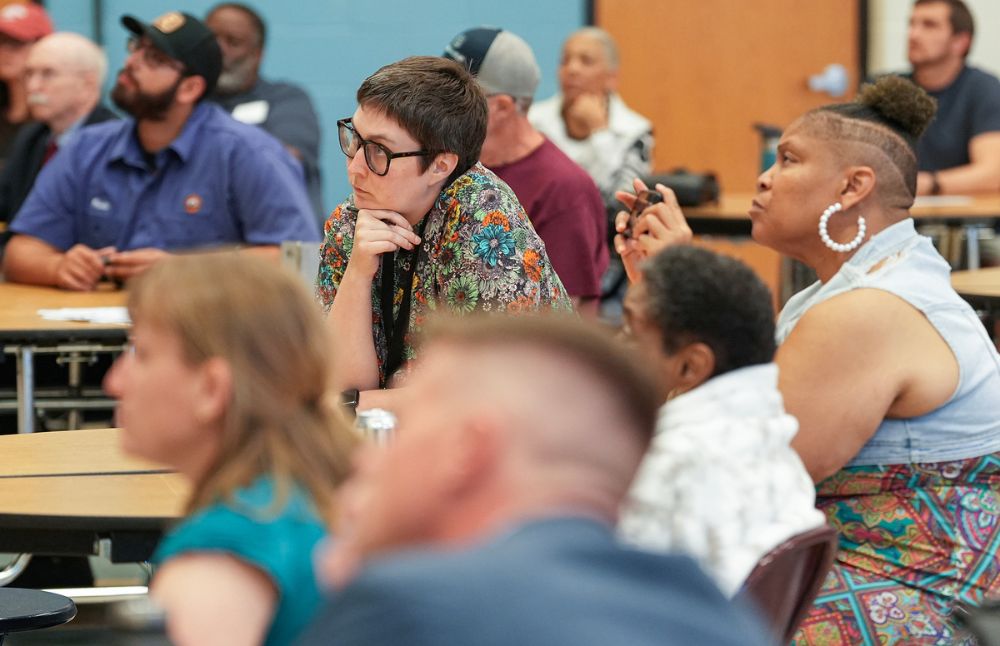
If you walk around your neighborhood and spot a welcome sign, a vibrant painting on a utility box or a community garden, chances are those were paid for with the help of a local grant.
Grants are money that you can apply for to fund a specific project or program. Organizations like the Indy Arts Council, Earth Charter Indiana and the Indianapolis Neighborhood Resource Commission offer smaller-scale grants — up to $10,000 — that can help you complete your own neighborhood project.
We gathered a list of grants to get you started. Plus, folks who hand grants and neighborhood leaders who have received grants and share advice for applying.
Use these grants to throw a block party, grow food or paint a mural
If you’re interested in learning more about how to search for grants, the Indianapolis Public Library hosts a nonprofit workshop series. The first session is an introduction to searching a platform called Candid for grants. The workshop is at 10:30 a.m. Sept. 5 at Central Library, 40 E. St. Clair St.
Block party grants
Offered by: Meridian Kessler Neighborhood Association
Amount: Up to $200
Apply: Now through September
Residents of Meridian Kessler can get $200 grants to bring neighbors together for a block party. First-time applicants are priority picks, and the neighborhood association gives out 10-15 grants each year.
Neighborhood leaders define Meridian Kessler as 38th Street to the south, Kessler Boulevard to the north, Meridian Street to the west and the Monon Trail to the east.

Vi Walker grants
Offered by: Meridian Kessler Neighborhood Association
Amount: Up to $5,000
Apply: January-March
For 27 years, this grant program has used the money from the Meridian Kessler home tour to support local nonprofits. Anyone in Indianapolis can apply for this grant, as long as the services they provide have some impact on people in Meridian Kessler.
Past grants have gone to put solar panels on a local school and to purchase hygiene items to hand out to women who are unhoused.
Indiana Humanities mini-grants
Offered by: Indiana Humanities
Amount: Up to $1,000
Apply: Applications are open on a rolling basis, due the last day of each month.
Want to teach a workshop about neighborhood history or encourage kids in your community to read? You can submit your ideas about history, literature, philosophy, ethics or law for a grant up to $1,000.
Nonprofits, schools, libraries, churches and government organizations can apply, but must be able to raise a one-to-one match for how much money you’re requesting. Follow the online instructions, and send questions to grants@indianahumanities.org.
Water Access Program
Offered by: Earth Charter Indiana
Apply: Starting in mid-August. Applications open until funding runs out.
This grant offers water cisterns to urban farmers and gardeners in Marion County, so they can get a regular supply of water to the food they’re growing. It’s part of Earth Charter Indiana’s Roots to Rise fund.
Grower Micro-Grants
Offered by: Earth Charter Indiana
Amount: Up to $1,000
Apply: Starting Aug. 24
Community gardens, urban farms and co-ops can apply for these micro-grants to get new or updated equipment, such as rain barrels or lights. Your farm or garden must be in Marion County, and Earth Charter Indiana asks that you not use AI to complete your application.
Climate and Democracy Catalyst Fund
Offered by: Indianapolis Foundation
Amount: $5,000 to $10,000
Apply: Before Sept. 4 for round three and before Nov. 20 for round four.
Nonprofits that want to make democracy more inclusive or that are focused on the environment can apply. For example, this grant helped the Southside U.S. Colored Troops Coalition start a climate action plan for the southside and teach neighbors what environmental justice means.
Legacy Allies
Offered by: Indianapolis Neighborhood Resource Center
Amount: $300 for participating in the training; can apply for a $5,000 grant
Apply: More information will be available in 2027.
The Indianapolis Neighborhood Resource Center, or INRC, funds small neighborhood projects through Legacy Allies and another program, the Indianapolis Community Building Institute. Neighborhood groups spend months getting trained on how to lead, work alongside city systems and tell their area’s history. At the end, they apply for $5,000 grants.
Related

Legacy Allies program trains new generation of neighborhood leaders
The program will focus on the Martindale Brightwood, Norwood and Northwest Landing neighborhoods.
Facade and Property Improvement Program
Offered by: LISC Indianapolis
Amount: 50% of the cost of projects from $1,000 to $10,000
Apply: Before 11:59 p.m. Sept. 2
Do you own a small business or a property in Indy? If it needs a refresh for better curb appeal, you can apply for this rebate to get back 50% of what you pay for improvements. You can also get connected with Indy Arts Council to paint a mural on your building.
Spark Good Local Grants
Offered by: Walmart
Amount: $250 to $5,000
Apply: Aug. 1-Nov. 30
Charities, government agencies, schools and churches can apply to win money to address a specific community need. That can look like adding more green spaces to your area or doing employment training. To apply, you have to make a Spark Good account.
What makes a grant application great
We talked to neighborhood leaders who have successfully applied for grants and used the funds to make their neighborhood better.
On the Near Eastside in Emerson Heights, Mariam Alam has had leadership roles in the neighborhood association for more than 30 years. The Emerson Heights Community Organization got a grant from the Indy Arts Council to paint a signal box in their neighborhood.
Related

Turn those boring gray signal boxes into works of art
Neighborhood associations can partner with Indy Arts Council to create colorful public art pieces.
Over in Bellaire, near the Indiana State Fairgrounds, neighborhood association president Ivan Holder got a grant from the Indianapolis Neighborhood Resource Center to start a community garden outside of a church.
Kris Matel has spent the last three years as grants chair for the Meridian Kessler Neighborhood Association. With a committee, she determines who gets grants from the Vi Walker program.
The Indianapolis Neighborhood Resource Center is an organization that gathers neighborhood resources all in one place. As deputy director, Sharon Logan trains neighborhood leaders and offers neighborhood grants.
Here’s what they have learned from their experiences.
What’s the best way to look for grants?
Mariam Alam
“Before the internet, I used to have to go to the library and look for grants in catalogs. Joking aside, online research is a good way to find grants for specific projects.
“I’ve learned about some grant opportunities by word of mouth through other neighborhood groups. Neighborhood organizations networking with each other is the best way to find out about what grant programs are out there. All of the other grants we’ve done, we heard about through the Indianapolis Neighborhood Resource Center. We work with Sharon Logan (slogan@inrc.org). Sharon probably has recommendations for other neighborhoods you can talk to that have done projects funded through other grants.”

Sharon Logan
“I encourage neighborhood leaders to build relationships with local hospital systems; universities and colleges; neighborhood banks; local businesses or major employers with a presence in their neighborhood.
“In many cases, successful neighborhood projects are funded through a combination of small donations, sponsorships, volunteer support and grants, rather than a single funding source. Building those local relationships can be just as valuable as finding the next grant opportunity”
Ivan Holder
“The Indianapolis Neighborhood Resource Center is excellent for community resources, and you can also find out about grants through your mayor’s neighborhood advocate, city-county councilor and U.S. Rep. André Carson’s office.”
Related

Meet your mayor’s neighborhood advocate
These 9 people serve as a bridge between Indy residents and city government. Here’s how to contact them.
What tips do you have for applying to grants?
Mariam Alam
- Come up with your own idea for what you want to prioritize. Don’t let which grants are available dictate what project you decide to do.
- Make sure the grant fits your project. If the grant is vague, call the organization awarding it and ask questions, so you don’t waste any volunteers’ time on applications that won’t be accepted.
- Carefully fill out the grant application. Questions can be repetitive, so read them carefully to figure out the differences between them.
- It’s better to be long-winded and clear than vague and concise.
Kris Matel
- Think through what audience your project would serve. When giving out grants, Meridian Kessler Neighborhood Organization looks for whether all kinds of people and all parts of the neighborhood are represented. They won’t give every award to a school, when they could also do something for older adults.
- Be specific about what the money would go toward if you win. For example, if they give out $5,000, they want to know how many scholarships that would fund.
A correction was made on Aug. 10, 2026: An earlier version of this article did not list Sharon Logan’s correct title. She is the deputy director of the Indianapolis Neighborhood Resource Center.
Mirror Indy, a nonprofit newsroom, is funded through grants and donations from individuals, foundations and organizations. Sign up for our free newsletters.
Mirror Indy reporter Sophie Young covers services and resources. Contact her at sophie.young@mirrorindy.org.